
LinkedIn has become the default platform for professional networking, career development, and B2B visibility. But growing on LinkedIn requires active engagement, not just posting and hoping for the best.
This guide covers everything from building your profile foundation to the specific tactics that actually drive results.
- Engagement signals (especially replies) carry disproportionate weight in the LinkedIn algorithm
- Responding to every comment on your posts is one of the highest-leverage actions you can take
- Content quality + consistent posting cadence + active community participation = sustainable growth
- Pages with complete profile info get 30% more weekly views: optimize your foundation first
Why Engagement Matters on LinkedIn
Engaging with your audience builds the relationships that make LinkedIn worth being on. When you interact with followers—responding to comments, reacting to their posts—they're more likely to do the same for yours.
The LinkedIn algorithm rewards posts that earn reactions, comments, and shares; the more of those a post collects early, the broader its subsequent reach. For B2B, the stakes are higher than most platforms: ignoring a comment on your post can cost you a deal.
Creating an Effective LinkedIn Profile
Content quality matters, but your profile is the foundation everything else sits on. A weak or incomplete profile loses you visitors before you've posted anything.
Pages with complete information get 30% more weekly views, meaning an unoptimized profile is losing you nearly a third of your potential reach before you've posted anything.
For a deep dive on this, see our guide on LinkedIn personal branding and our roundup of the best LinkedIn profile examples.
Best Practices for LinkedIn Content Creation
Before people can engage with your content, you need to be creating content worth engaging with. If you're stuck on what to post, our guide to 22 types of LinkedIn posts that work well is a good starting point. Here are the core concepts to understand:
Provide Value in Your Content
Your posts should offer something worth stopping for: a new perspective, a useful framework, a data point people haven't seen. Generic takes get scrolled past.
The fastest way to be forgettable is to say what everyone else is already saying. Your angle, your experience, your specific take—that's what earns engagement and builds a recognizable voice.
Write Headlines that Build Curiosity
Your hook is the first thing people see. Without a good one, they scroll before reading a word. Our LinkedIn storytelling guide covers how to structure hooks that actually earn the "see more" click.
A simple test: read your first line and ask whether it earns the second. If someone could stop there and feel nothing was lost, the hook isn't working. Build curiosity, tease an insight, or open with a claim worth arguing about.
Use Visual Media (Images, Videos, & Slides)
A scroll-heavy feed is mostly text. Images, video, and document carousels stand out by contrast and get shared more often. LinkedIn's own data shows that posts with images generate a 98% higher comment rate than text-only posts.
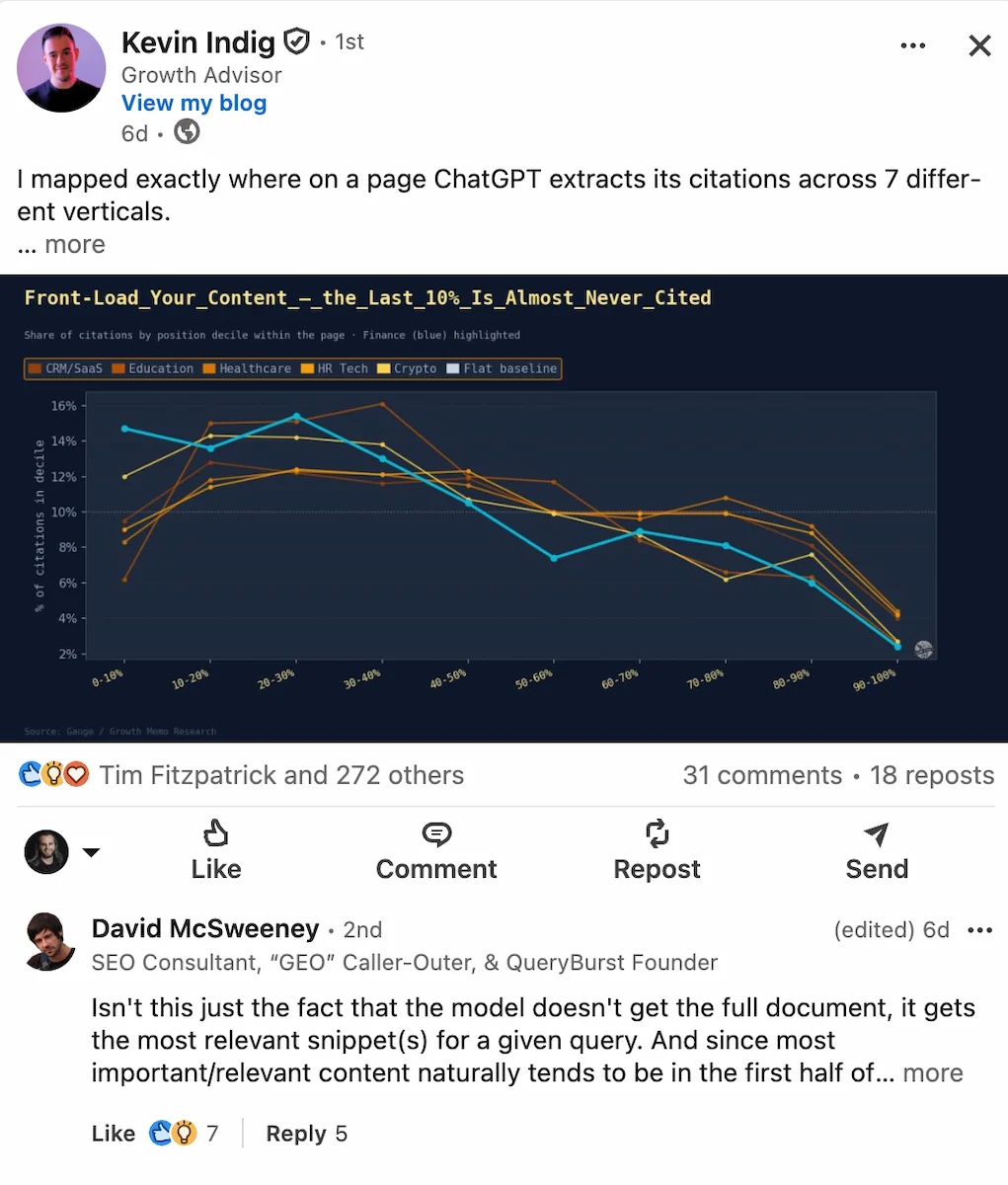
Also whenever possible look for opportunities to use screenshots in your posts. The standout parts of your unfiltered work life are exactly what people want to see on this platform: milestones, interactions, texts, Slack messages... don't publish confidential information of course, but the blur tool is your friend! And these posts can get heavy engagement and reach.
Whether it's images, short videos, or document carousels, visual media is easier to consume, especially for those scrolling quickly through their feed.
Should You Schedule Your Posts?
Planning ahead helps you stay consistent. Writing posts in batches means you're not scrambling during the week, which frees up time for the higher-leverage work of engaging with your community.
The downside: the further out you're writing, the harder it is to stay timely and specific, especially if you're producing many posts in a single session.
My recommendation: try it for a week and monitor your engagement vs. posting spontaneously. If you get better results and feel more efficient, it's a no-brainer.
7 Ways to Boost LinkedIn Engagement
Being active in your community—not just publishing—is what separates accounts that grow from those that plateau. Here are the practices worth implementing:
1. Comment on Content in Your Feed
Check your feed regularly for content from people in your network. Showing up consistently in others' comment sections builds reciprocity over time: they notice, and they return the favor.
The key word is genuinely. Provide value in your comments—offer an insight, ask a real question, share a relevant experience. Comments that add nothing get ignored; comments that add something get noticed.
2. Share and Amplify Others' Content
Sharing content from other creators builds goodwill and may prompt them to return the favor. But only share things you'd actually stand behind. Your audience will notice if you're promoting posts that don't land for them, and it reflects on your judgment.
3. Create and Promote LinkedIn Articles
Long-form articles give you room that a standard post doesn't: space to actually develop an argument, walk through a case study, or document a process. They take more effort upfront, but a well-written article becomes a source of future post ideas rather than a one-off piece of content.
When writing articles, focus on:
- A compelling headline that draws attention
- Relevant visuals like images or infographics
- Content that educates, inspires, or provokes thoughtful discussion
Avoid overly promotional language, and proofread before publishing. Spelling errors and poor grammar detract from your credibility.
4. Share Your Articles Beyond LinkedIn
Once you've published, share the article to your other channels—email list, social profiles, company blog. Cross-promotion drives traffic back to your LinkedIn article and compounds the distribution you've already built elsewhere.
5. Reply to Every Comment You Receive
Every unanswered comment is a missed signal. Replying keeps the conversation alive, rewards the person who took the time to engage, and gives the algorithm evidence that the post is worth distributing further.
LinkedIn's algorithm isn't publicly available, but Twitter open-sourced its algorithm, and we can draw useful parallels. Here's what the Twitter data looks like:
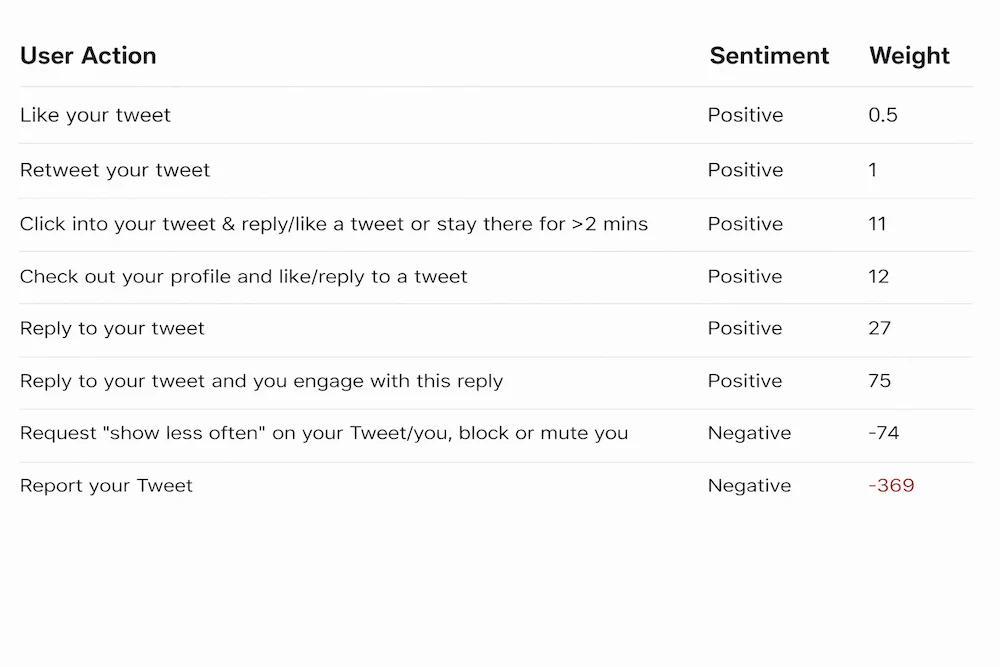
The data shows that your reply to a comment on your post is worth dramatically more than a like or repost. Although this is Twitter's algorithm, LinkedIn almost certainly implements something similar: engagement quality matters far more than engagement volume.
Either way, responding to every comment builds relationships with the people commenting, making them more likely to engage with your future content.
6. Tag Colleagues and Peers in Posts
When you tag someone in a post, they get a notification and are more likely to engage. That engagement signal then helps distribute the post further.
Use it when the tag is genuinely warranted—when the person has a real connection to what you're saying. Tagging people randomly or just to grab attention tends to backfire.
7. Use LinkedIn Live for Real-Time Engagement
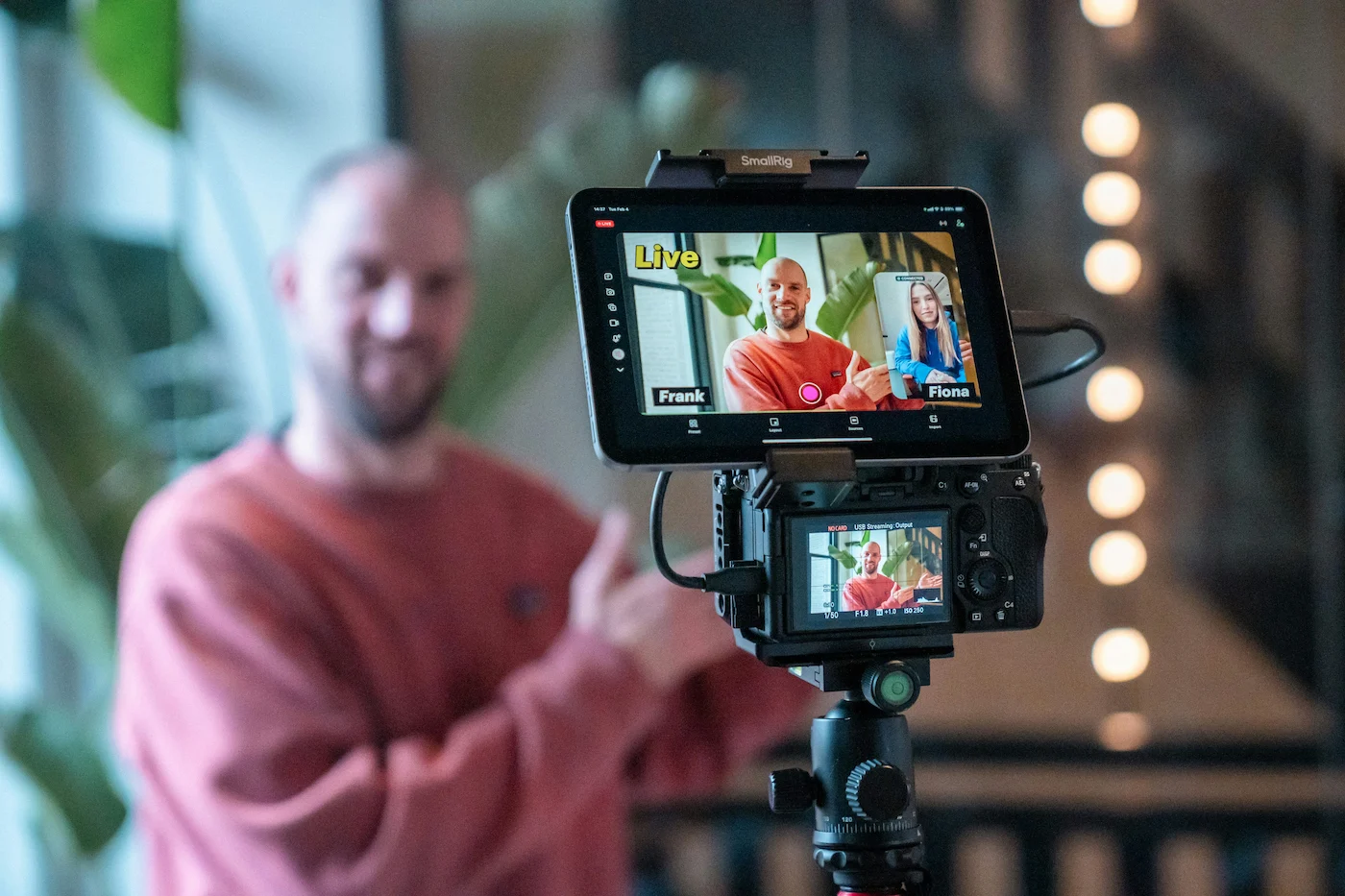
LinkedIn Live lets you broadcast real-time video to your network, with live reactions and comments as it happens. It creates a type of connection that recorded content can't replicate—people who show up for a live session are paying a different kind of attention.
LinkedIn reports 24x more comments on Live sessions compared to standard posts. Starting to livestream can feel like a barrier, but the reach upside is real once you have an audience worth broadcasting to.
Read Your LinkedIn Analytics to Find What's Working
The LinkedIn Analytics page gives you per-post performance, follower demographics, and best posting times. Check it regularly—it's the only way to know whether your strategy is actually working or just feels like it is.
If you're running LinkedIn Ads, the same dashboard covers ad performance and ROI. Review it on a consistent cadence and adjust based on what the data shows, not what you expect.
Beyond LinkedIn's native analytics, tools like DemandBird's post grader help you benchmark individual posts and understand which content formats and topics are working, before you commit to repeating them.
Mistakes to Avoid for Better LinkedIn Engagement
Most of these are easy to slip into. Here's what to watch for:
Playing It Too Promotional
LinkedIn is a place to build credibility, not run a sales pitch on repeat. Posts that only talk about your product or service burn audience trust fast.
Earn the right to promote by being useful first. Share insights, opinions, and practical information—then when you do promote something, people are already paying attention.
Posting Without Listening
LinkedIn works both ways. If you're posting without paying attention to what actually lands with your audience, you're guessing. Watch your analytics, notice what resonates, and adjust. Ask questions in your posts. The more you treat it as a conversation rather than a broadcast, the better your engagement will be.
Treating Reach as Proof That a Post Is Working
High reach and high business impact are not the same thing, and conflating them will quietly wreck your content strategy.
Here's a concrete example. One of my own posts about AI doom predictions got 8,000+ impressions in under 24 hours, which is well above average for my account. The post hit a nerve, people shared it, and the numbers looked great.
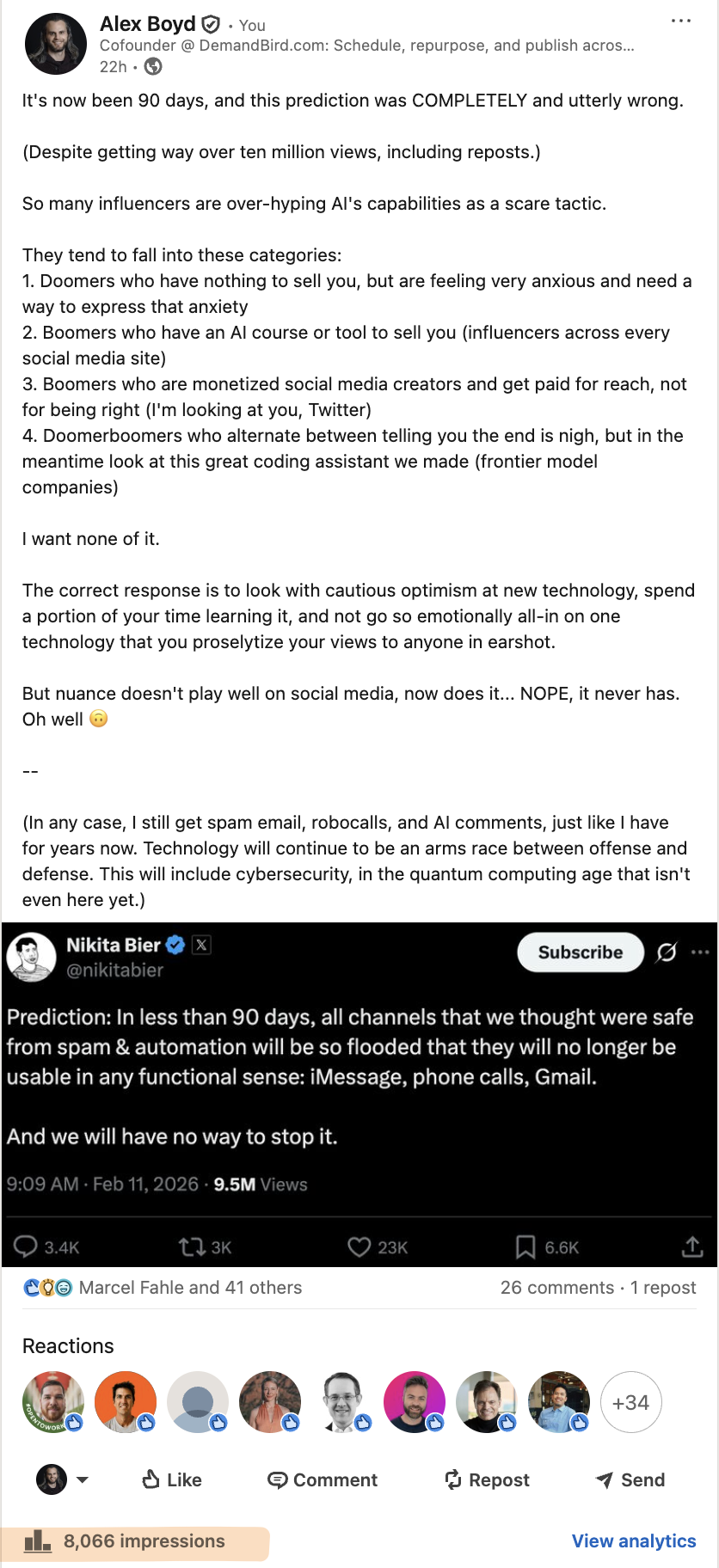
But the topic had nothing to do with DemandBird. It was a take on AI influencer discourse, not on social media scheduling or LinkedIn analytics. The reach was real. The lead generation was essentially zero.
This maps directly onto a pattern that comes up constantly among B2B LinkedIn users. In a recent Reddit thread in r/SocialMediaMarketing, a marketer asked why their detailed client case studies (10 likes, a few congratulations comments) kept getting crushed in the metrics by generic framework posts (400 likes, 50 shares). My response:
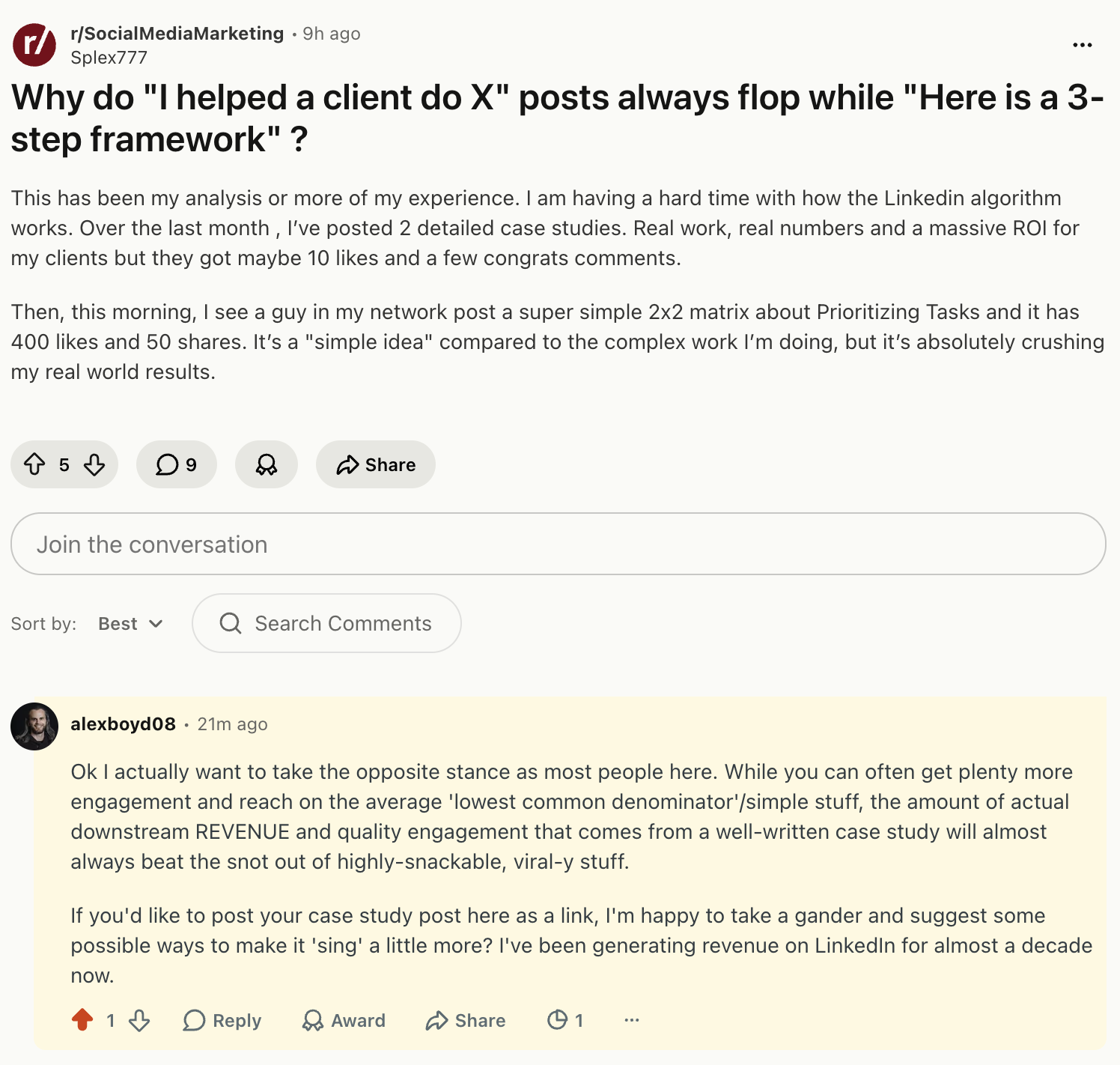
The case study "loses" on reach and likes. It wins on revenue, because the people who stop to read a detailed, specific case study are almost always prospects actively evaluating whether they have the same problem. The framework post travels further but lands on a much more diffuse audience.
A useful way to think about your content mix:
- Awareness content casts a wide net. Trending takes, relatable observations, broadly applicable frameworks. High reach, low conversion. Its job is to grow your audience and stay visible to people who don't know you yet.
- Engagement content earns real conversation: questions, strong opinions, things your specific audience cares about enough to argue with. Medium reach, stronger relationship-building signal.
- Conversion content is specific and product-adjacent: case studies, pointed takes on your customers' exact problems, comparisons, proof. Lower reach, but the people who engage are much closer to buying.
All three serve a purpose, and a good LinkedIn strategy includes all three. The mistake is letting awareness content crowd out conversion content because it makes the dashboard look better. Track reach and engagement as leading indicators, but track pipeline and inbound conversations as the lagging ones. Those are the numbers that actually tell you if the effort is working.
Erratic Cadence
Going quiet for weeks and then posting a flurry of content doesn't build an audience—it confuses one. Pick a cadence you can actually hold, whether that's once a day or three times a week, and plan your posts in advance so you're not scrambling. Consistency is one of the few real advantages you can build on LinkedIn.
Treating the Algorithm as Static
LinkedIn's algorithm changes how it distributes content over time. What worked in 2023 doesn't always work in 2026. Stay aware of shifts—our LinkedIn algorithm guide is kept up to date—and adjust your approach when the data suggests something has changed.
Building a Long-Term LinkedIn Engagement Strategy
Growing your LinkedIn account is a long game. By expanding your time horizon and staying consistent, you'll see compounding growth month over month. Here's what to focus on:
Set Measurable Goals and KPIs
Know what you're measuring before you start: new connections per month, engagement rate, specific relationships you want to build. Without clear targets, you can't tell whether your effort is compounding or just spinning.
Regularly Review and Update Your Profile
Your profile is the first thing people check after seeing a post they liked. Keep your headline, summary, and photo current—stale profiles lose visitors that your content already earned. A well-optimized profile converts viewers into followers and followers into leads.
Monitor Trends
Trending topics get traction because people are already primed to engage with them. Stay on top of what's happening in your industry—when something relevant breaks, being one of the first to weigh in can deliver reach that a regular post wouldn't.
Conclusion
LinkedIn rewards presence, not just output. The connections you build and the content you share compound over time—but only if you're actually engaging, not just broadcasting.
Publishing alone isn't enough. Show up, respond, and be genuinely present in your community.
Want to understand which of your posts are actually driving engagement? Check out our free LinkedIn post grader, or read our deeper guide on getting more impressions on LinkedIn.
Frequently asked questions
What is a good LinkedIn engagement rate?
For your own audience, 0.5%–6% is a typical range, but engagement rate is easily misread. When a post goes viral and reaches a much wider audience than your followers, engagement rate will naturally drop, because that extended audience engages at a lower rate than people who already follow you. A lower engagement rate post is not necessarily a bad post. For a fair comparison, look at engagement rate while controlling for reach, and don't penalize posts that LinkedIn decided to push to a broader audience.
Does replying to comments help your post reach more people?
Yes, and more than most people realize. Replies count as comments, and comments are among the highest-weighted engagement signals in LinkedIn's algorithm. Replying to every comment effectively doubles the comment count while encouraging the original commenter to re-engage, generating additional signal. Responding in the first hour after posting has the most impact on distribution.
How often should you post on LinkedIn to build engagement?
Consistency matters more than frequency. 3–5 quality posts per week will outperform daily posting with variable quality. But more important than post frequency is engagement frequency: commenting on others' posts, responding to DMs, and being present in conversations drives visibility that no posting cadence alone can replicate.
Do LinkedIn Groups still drive engagement in 2026?
Generally no. LinkedIn Groups have been largely dormant for years and rarely drive meaningful engagement or reach. Most active professional conversations happen in the main feed, in post comments, and in direct messages. Investing significant time in Groups is unlikely to pay off for most LinkedIn users in 2026.
Is LinkedIn Live worth the effort for engagement?
It can be, but it requires an existing engaged audience. LinkedIn Live sessions generate strong algorithmic signals when people watch and interact, but if your network isn't already active, a live with few viewers will underperform a well-written post. It amplifies an existing presence rather than building one from scratch.
Understand what's working on your LinkedIn
DemandBird helps B2B teams grow their social media presence, without the guesswork.
Start Free Trial