
Most LinkedIn advice tells you to either "be authentic" or to use "viral templates". But that doesn't really help you: what if your authentic stories aren't written in a compelling way? And worse, what if you use viral templates but they fall flat and you can't back them up, leading to low or no revenue generation?
Instead, here I'll share how to structure a story. Not just any story, but one that leads back to revenue and brand growth for you. After all, that's the whole point of company social media!
What Is LinkedIn Storytelling?
LinkedIn storytelling uses compelling narrative structure to make a professional point.
I do not mean you should tell fictional tales, dump your personal trauma, or offer "fake vulnerability" in the name of storytelling. (Don't take the name of storytelling in vain, please!)
Why Storytelling Works on LinkedIn
We're hardwired to understand things in the format of a story. Stories have helped us survive, avoid danger, create social glue, and allowed us to "live events without experiencing them" for tens of thousands of years. And humans evolve slowly: so, investing in your storytelling skills is a recipe for career growth and revenue generation from your content.
Stories build trust because they show experience, not just opinion. They're more compelling, memorable, and relatable. And of course, storytelling is a delivery mechanism for expertise, not a substitute for it. In other words: faking a story might pretend to get you temporary memorability, but you won't be able to back it up (since it's not truly your expertise), so please have high integrity and never tell fake stories.
The Anatomy of a Great LinkedIn Story
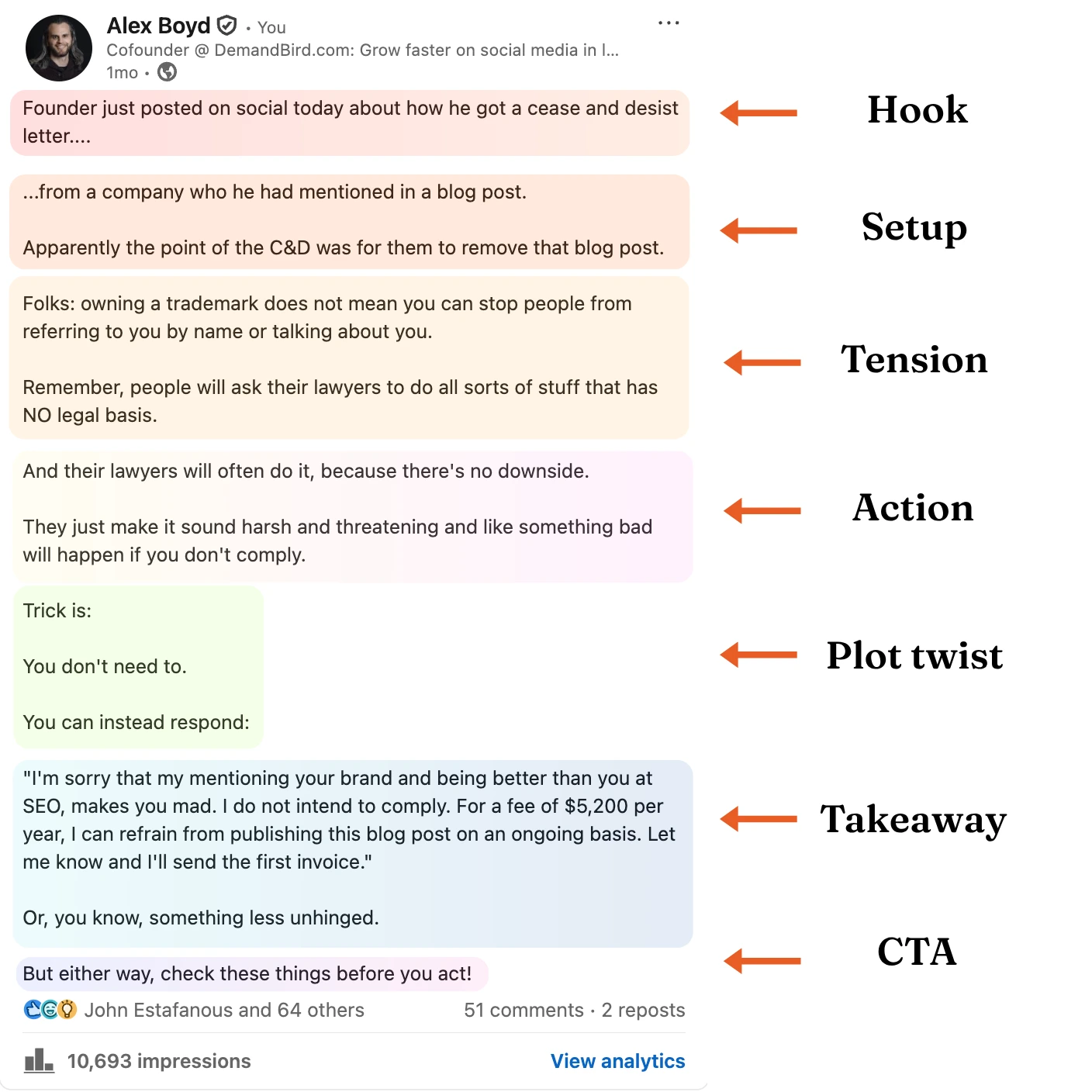
Here's an example from one of my posts that got over 10,000+ impressions, and the framework it used:
The Hook
A compelling event, piece of action, information, or anything else that triggers a reaction in the reader. Ideally something that does not require them to know you or your background for it to be meaningful.
The Setup
Your hook won't be long enough to truly set up the story. You'll need a few more lines. In some cases, this will be half of your post.
The Tension
The underlying conflict of the story. By the way, if there's no conflict, there's no story!
The Action
This is the meat of the story: its actual events.
The Turning Point
A reframe, perspective shift, or plot twist, that adds surprise or changes the direction. This is what makes a story good or not.
The Takeaway
For a LinkedIn post, this is usually some sort of professional lesson.
The CTA
You recognize what a call to action is, already! But I want to emphasize: this does not mean a CTA of "buy from me". It can be a CTA of just, literally, any action you call them to. If you want a second opinion on whether your ending actually works, try our LinkedIn Post Grader.
A Simple LinkedIn Storytelling Framework
Most story frameworks are essentially the same; if someone is trying to convince you that there's just one framework that "works the best all the time", that person is either selling you a LinkedIn course or uncreative.
Here are a few examples you can keep in mind if frameworks are helpful to how you think:
- Moment → Problem → Lesson
- Mistake → Realization → Change
- Challenge → Decision → Result → Insight
Pick your favorite. Any of them will do. The shorter, the better... as long as you don't leave out key parts!
LinkedIn Story Hook Examples
This is one of the toughest parts of writing a good story, so I wanted to spend some time on this section in particular. And: please don't copy and paste these verbatim (not that I care if you do, but they'll work better if they're original and authentic to you!). If you want more ideas for formats beyond story-led posts, see our guide to LinkedIn post types.
- How to buy a SaaS in <30 days for less than $5k:
This feels compelling if you're someone who wants to acquire a SaaS company but believes it takes a lot of budget to do so. - 2021: Lost, confused with no leads coming in.
2026: Sales team working warm leads, never worried about pipeline, $5M company run rate.
This appeals to people who are in the middle stage of starting and growing their company to a $5M run rate: you want to know how you can also get to that promised land. - Since starting my company, I've made $2M worth of costly mistakes.
You're going to click "see more" on that post because you want to avoid making the same mistakes I've made. This is the equivalent of "hey I went to this clearing and there was a den of lions, don't go there": you want to know which path to not take!
Hopefully, you get the idea. For a story to do well, it should start with an objectively compelling hook (not one that appeals only to you and people who know you), and it should introduce some tension.
Common LinkedIn Storytelling Mistakes
When you've drafted your story, run through this checklist to proof it:
- is the hook objectively compelling to someone who doesn't know me and my background?
- does the hook 'cut straight to it' or am I indulging in unnecessary preamble?
- is there any tension in the story, or am I skipping straight to the takeaway?
- does the story flow from beginning to end, or is there key information missing?
- am I including too much detail and losing people's attention?
- are there words or phrases I can cut while keeping the meaning intact?
- is my takeaway clear?
- is this a true story, not one I've made up to illustrate a point?
- am I forcing a sales pitch at the end? e.g. "and this is what it taught me about b2b sales"
But when you're in doubt, don't worry: your analytics don't lie!
If you don't have a good way of keeping track of your social media performance and post scheduling for your stories, consider using our product to do that. There's a free trial so you can try before you subscribe!
How to Measure Whether Your Stories Are Working
Generally, if your post gets more reach or engagement than average, that's a good sign it worked well:
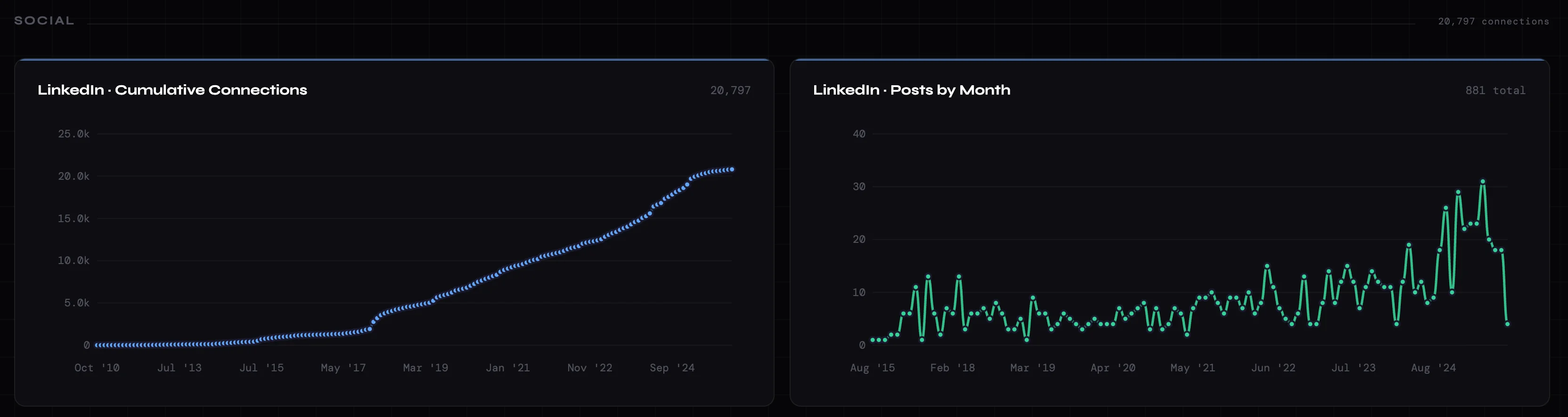
But be wary of relying too much on just the hard numbers. Look at the character of the comments you get, and any private feedback as well: did your story inspire, change minds, or drive behavior? That's the real measure of whether it was successful.
Overall, this is the gold standard:
I look at my stories in terms of whether they drove behavior and belief change in my ideal customers' minds, that ultimately contributed to them becoming better-educated and more likely to buy from me.
Frequently asked questions
What makes a good LinkedIn story?
A good LinkedIn story has three things: a compelling hook, real tension, and a clear takeaway. If there's no tension, there's usually no story, just an update. And if there's no takeaway, the reader is left wondering why they spent time reading it.
The best LinkedIn stories don't just entertain people. They help your audience understand something useful about business, leadership, hiring, marketing, sales, or whatever you want to be known for.
Should LinkedIn stories be personal or professional?
Either can work, but the best-performing stories usually connect the personal to the professional. You don't need to overshare or turn your feed into therapy. You just need to tell stories that reveal something meaningful about how you think, what you've learned, or what your audience can apply in their own work.
A personal story with no business relevance is usually just self-expression. A professional story with no human element is usually forgettable. The sweet spot is the overlap.
How long should a LinkedIn storytelling post be?
As long as it needs to be, and no longer. Some stories work in 8 lines. Others need 25. The goal is not to hit a word count. The goal is to hold attention all the way through.
If a line doesn't increase tension, add clarity, or strengthen the takeaway, cut it. Strong stories feel tight, even when they're long.
Do storytelling posts perform better than advice posts?
Not automatically. A weak story will lose to a strong advice post every time. But when storytelling is done well, it often outperforms because it makes your expertise more memorable and persuasive.
Advice tells people what to think. Storytelling helps them experience why it matters. That's why stories tend to create stronger emotional buy-in, better recall, and more belief change.
Can companies use storytelling on LinkedIn too?
Yes, and they should. Company storytelling just looks a little different from founder-led storytelling. Instead of centering every post around one person's experience, a company can tell stories through customers, employees, product decisions, lessons learned, experiments, failures, wins, and behind-the-scenes moments.
In fact, companies that never tell stories usually sound sterile. And sterile content rarely builds trust or demand.
What's the biggest mistake people make with LinkedIn storytelling?
The biggest mistake is confusing storytelling with "sounding personal." A lot of people share personal details, but they don't actually tell a story. There's no real hook, no tension, no movement, and no lesson.
The second biggest mistake is forcing a sales pitch onto the end of the post. If the story is good, it already builds trust. You don't need to ruin it by stapling on a fake takeaway about why your audience should buy your service today.
Track which story posts actually drive revenue
DemandBird helps you schedule, review, and learn from your LinkedIn content so you can create more stories that move buyers.
Start Free Trial