
Introduction
A LinkedIn trainer teaches your people to do the work themselves. That makes training a different purchase from hiring a ghostwriter (who writes for one executive) or an agency (who runs the channel for you). Training is the right buy when you have a group of people who need to show up well on LinkedIn, and you want that skill to stay in the building after the invoice is paid. Think a sales team learning Sales Navigator, a leadership team building a presence, or an employee advocacy program that needs more than a Slack channel of links to share.
Below are six trainers and training firms I would point a B2B company toward. The list deliberately covers Italy, the Netherlands and Spain, the US, and Germany, plus one industry specialist. LinkedIn training works best in your team’s own language and business culture, and a translated English playbook rarely lands the same way.
This is a shortlist, not a scored ranking. Every person here has a real training practice you can check: named programs, named clients, and activity in 2026. Where I am relying on public evidence rather than my own experience with them, the profile says so.
Find Your Best-Fit LinkedIn Trainer
Tell us what you’re looking for and this basic AI-style matcher will suggest the top 2-3 trainers who fit your context. If the matches look right, add your email and we’ll reach out with intros.
Your best-fit options
We’ll reach out soon.
Quick Comparison: Top LinkedIn Trainers
| Trainer / Firm | Best For |
|---|---|
| Leonardo Bellini (LinkedInForBusiness) | Italian companies, and international firms with Italian teams, that want LinkedIn training in Italian from the market’s most established specialist |
| Richard van der Blom (Just Connecting) | European and North American enterprises rolling out social selling or employee advocacy in several languages, backed by algorithm data |
| Mandy McEwen (Luminetics) | US B2B and SaaS sales teams that want on-demand courses plus live virtual workshops, with AI tools built in |
| Darren McKee (Darren McKee Co.) | US founders, sales leaders, and AEs who want story-led, no-automation social selling taught by someone who built a 150K audience that way |
| Sims Tillirson (Tillirson Consulting Group) | Employee benefits brokers, HR-tech and benefits-tech sales teams, and insurance producers who want an industry insider |
| Britta Behrens | DACH companies rolling out social selling and corporate influencer programs to marketing and sales teams, in German or English |
Methodology: How this list was built
Short version: six trainers I would actually recommend, with a plain note on what each one is not built for.
- No paid placements. Nobody paid to be here. There are no affiliate links or referral fees.
- We don’t sell training. DemandBird is software, so we have no reason to rank one trainer above another.
- Trainers only. Everyone here makes their living teaching teams and executives to use LinkedIn themselves. Ghostwriters, ads agencies, and course-sellers aimed at solo creators are on other lists.
- Selection criteria. A structured, named program; named clients or client results you can check; and visible activity in 2026.
- Ordered by use case, not ranked. The right pick depends on your country, your language, and whether you are training salespeople, executives, or employee advocates.
1) Leonardo Bellini (LinkedInForBusiness)
Best for: Italian companies, and international firms with Italian sales and marketing teams, that want LinkedIn training delivered in Italian by the most established specialist in that market.
If you sell into Italy, this is my pick, and it is not a close call. Italian business culture on LinkedIn has its own rules: more formal, relationship-first, and slower to trust cold outreach than the US or UK. A trainer who lives inside that culture will beat a translated English playbook every time.
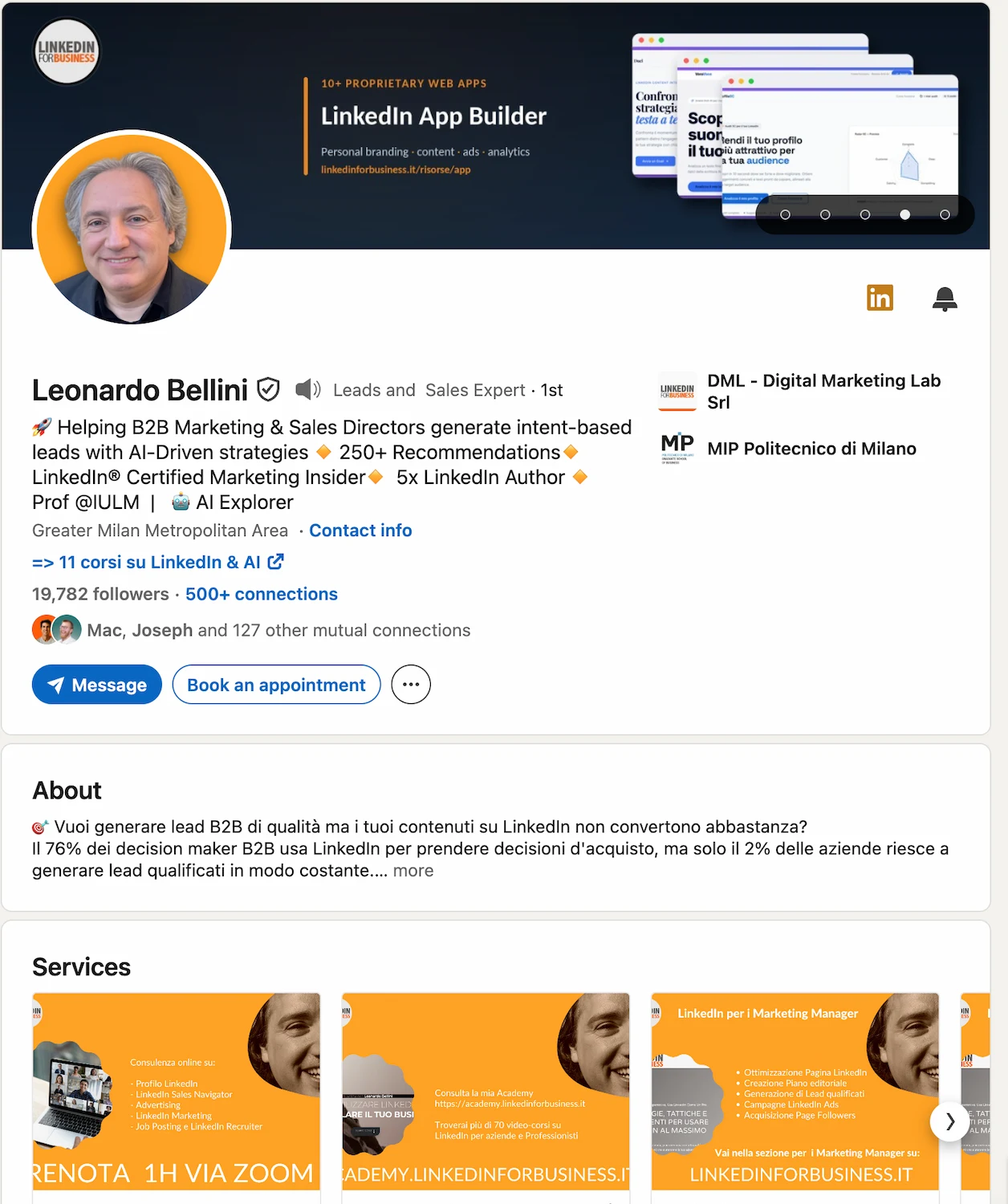
Leonardo Bellini has trained Italian companies on LinkedIn since 2015 through LinkedInForBusiness, the training brand of his Milan consultancy DML - Digital Marketing Lab, which he founded in 2011. Before that he spent around two decades in telecom and internet companies, so he talks to sales and marketing leaders as a peer rather than a social media guy. He describes himself as a five-time LinkedIn author, with Italian-language titles including Come usare LinkedIn per il tuo business, Social Selling, LinkedIn Tips, and La pubblicità su LinkedIn. He is a LinkedIn Certified Marketing Insider, hosts the LinkedInForBusiness podcast, and teaches at IULM and MIP Politecnico di Milano.
The training is split by function, which is rarer than it should be. Marketing teams get company page, content, and lead generation. Sales teams get prospecting, Sales Navigator, and social selling. HR gets LinkedIn recruiting, employer branding, and employee advocacy. On top of the in-company courses there is an online academy with 70+ video courses, a set of his own LinkedIn web apps for profile, content, ads, and analytics, and a 30-hour “LinkedIn AI Mastery” cohort capped at 20 people, aimed at managers and professionals doing social selling with AI tools.
Named clients include 3M Italia, UnipolSai, Esker Italia, Aggreko Italia, and Nielsen. His profile carries 250+ recommendations, and Favikon listed him among the top 20 LinkedIn experts in Italy in 2025.
Site: linkedinforbusiness.it · Profile: linkedin.com/in/leonardobellini
Not the right fit if: you need English-only delivery for a global team, or your people sit outside Italy. Everything he publishes is Italian-first, and that is exactly why he works so well for the Italian market.
Why he stands out
- The most established LinkedIn trainer in Italy, active on the platform since 2015
- Five LinkedIn books in Italian covering the platform, social selling, and LinkedIn ads
- Separate tracks for marketing, sales, and HR instead of one generic workshop
- Enterprise clients including 3M Italia, UnipolSai, and Nielsen
- Teaches at IULM and MIP Politecnico di Milano, and hosts a long-running LinkedIn podcast in Italian
2) Richard van der Blom (Just Connecting)
Best for: European and North American enterprises that want a multi-language social selling or employee advocacy program, backed by the most-cited data on how the LinkedIn algorithm actually works.
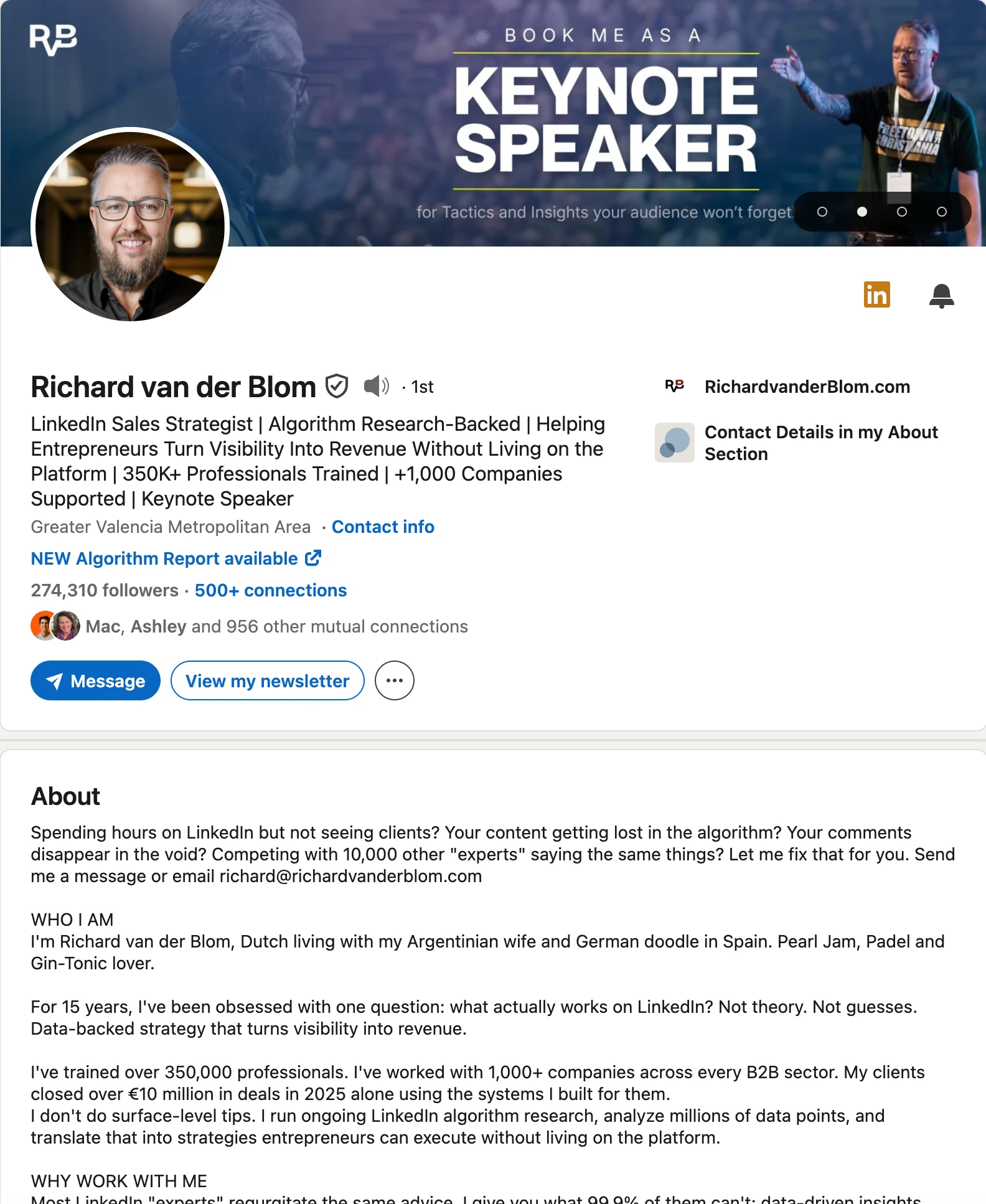
Richard van der Blom founded Just Connecting in the Netherlands in 2009 and now runs it from Valencia, Spain, with an international team of partner trainers. Most people know him for the annual Algorithm Insights Report, which he has published since 2020. The 2026 edition is the seventh, built on 1.3 million posts from 50,000 creators, and it gets cited by companies like Salesforce, PwC, and Nestlé. We lean on it ourselves in our guide to the LinkedIn algorithm. He also published a book, Connect, Qualify, Close, in 2025.
The training side is the Just Connecting HUB: social selling, Sales Navigator, virtual selling, employee advocacy, personal branding, employer branding, and keynotes, organized around his B.E.S.T. social selling method. What makes it enterprise-grade is delivery. Programs run in seven languages (English, Dutch, German, French, Spanish, Italian, and Portuguese) through partner experts in each market, so a company with teams in Amsterdam, Munich, and Madrid can run one program instead of three.
Named clients include Nestlé, NetApp, Salesforce, Philips, Teva, InterSystems, Capgemini, Siemens, and PwC. His own profile puts the count at 350,000+ professionals trained and 1,000+ companies supported, with clients closing more than €10 million in deals in 2025 using his systems. For individuals there is the TRIBE membership at about €1,000 a year, with monthly live masterclasses and a library of recorded workshops.
Site: justconnecting.nl · richardvanderblom.com · Profile: linkedin.com/in/richardvanderblom
Not the right fit if: you are a solo founder or a five-person team. The corporate programs are built for enterprise rollouts. If you just want the thinking, the algorithm report (about €199, with a corporate license available) or the TRIBE membership is the cheaper way in.
Why he stands out
- Author of the Algorithm Insights Report, the most-cited independent study of LinkedIn reach
- Programs delivered in seven languages through local partner trainers
- 350,000+ professionals trained; enterprise clients include Nestlé, Salesforce, Philips, and Siemens
- Covers sales, marketing, HR, and executives under one method
- In business since 2009, so the practice has outlasted several algorithm changes
3) Mandy McEwen (Luminetics)
Best for: US B2B and SaaS sales teams that want a structured social selling and Sales Navigator program, combining on-demand courses with live virtual workshops and AI tools.
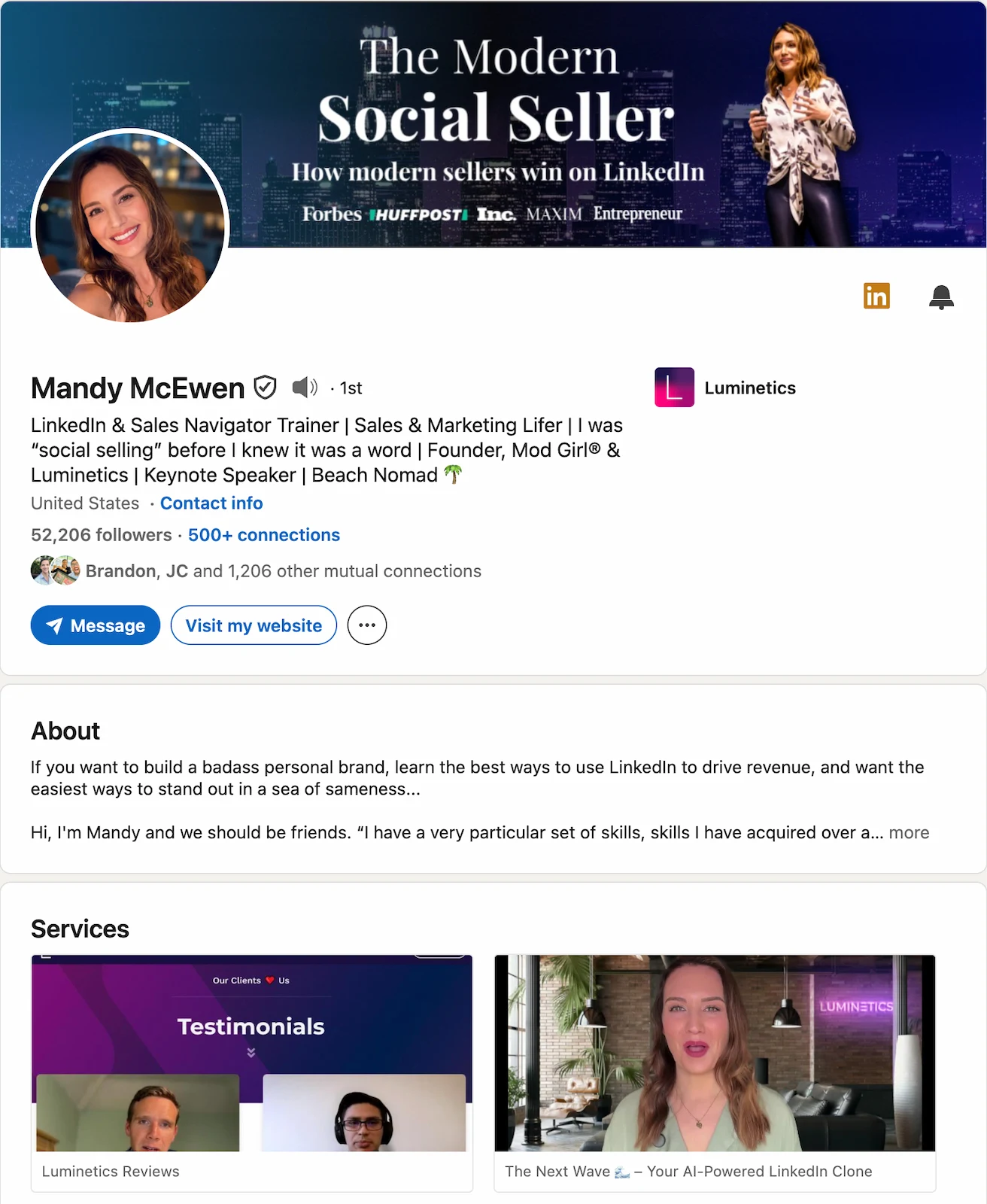
Mandy McEwen started Mod Girl Marketing in 2010 and launched Luminetics in 2021 as a B2B social selling consultancy focused on LinkedIn and Sales Navigator training for teams. The flagship program is Modern Social Seller: 12 months of access to five on-demand courses (Sales Navigator Mastery, LinkedIn Messaging Mastery, LinkedIn Profile Profits, Posting Power, and Lights Camera Conversion), plus monthly group workshops, custom AI tools and GPTs, playbooks, and a private Slack community. It starts at $1,000 per person with a 30-day refund guarantee. Teams can take the self-guided version or pair it with live virtual training customized to their sales motion.
For leaders there is Executive Influence, a personal branding program that promises a solid LinkedIn presence within 90 days. Her results claim, in her own words, is 150+ reps trained across more than 10 companies, with a 30 to 50 percent increase in pipeline within 90 days. Client testimonials on her site come from teams at Disperse and ExtraHop.
She has been named a LinkedIn Top Voice in social selling, spoke at Social Media Marketing World in 2022 and is on the 2026 lineup, and has been featured in Forbes, HuffPost, Inc., and Entrepreneur. Of everyone on this list she leans hardest into AI, with the Lumi AI Profile Builder and a separate AI go-to-market membership.
Site: luminetics.io · Profile: linkedin.com/in/mandymcewen
Not the right fit if: you want in-person, on-site workshops as the main format, or a program built around a non-US market. Luminetics is mostly virtual and US-centric, which is a feature for distributed American sales teams and a limitation for everyone else.
Why she stands out
- Clear, priced program (from $1,000 per person) with a refund guarantee, which is rare in this category
- Five on-demand courses covering profile, posting, messaging, video, and Sales Navigator
- Pipeline-focused results claims from real sales teams
- AI tools and GPTs built into the training rather than bolted on
- 17+ years in digital marketing and sales, with Mod Girl Marketing running since 2010
4) Darren McKee (Darren McKee Co.)
Best for: US founders, sales leaders, and account executives who want to learn story-led, no-automation social selling from someone who built a 150,000-follower audience doing exactly that.
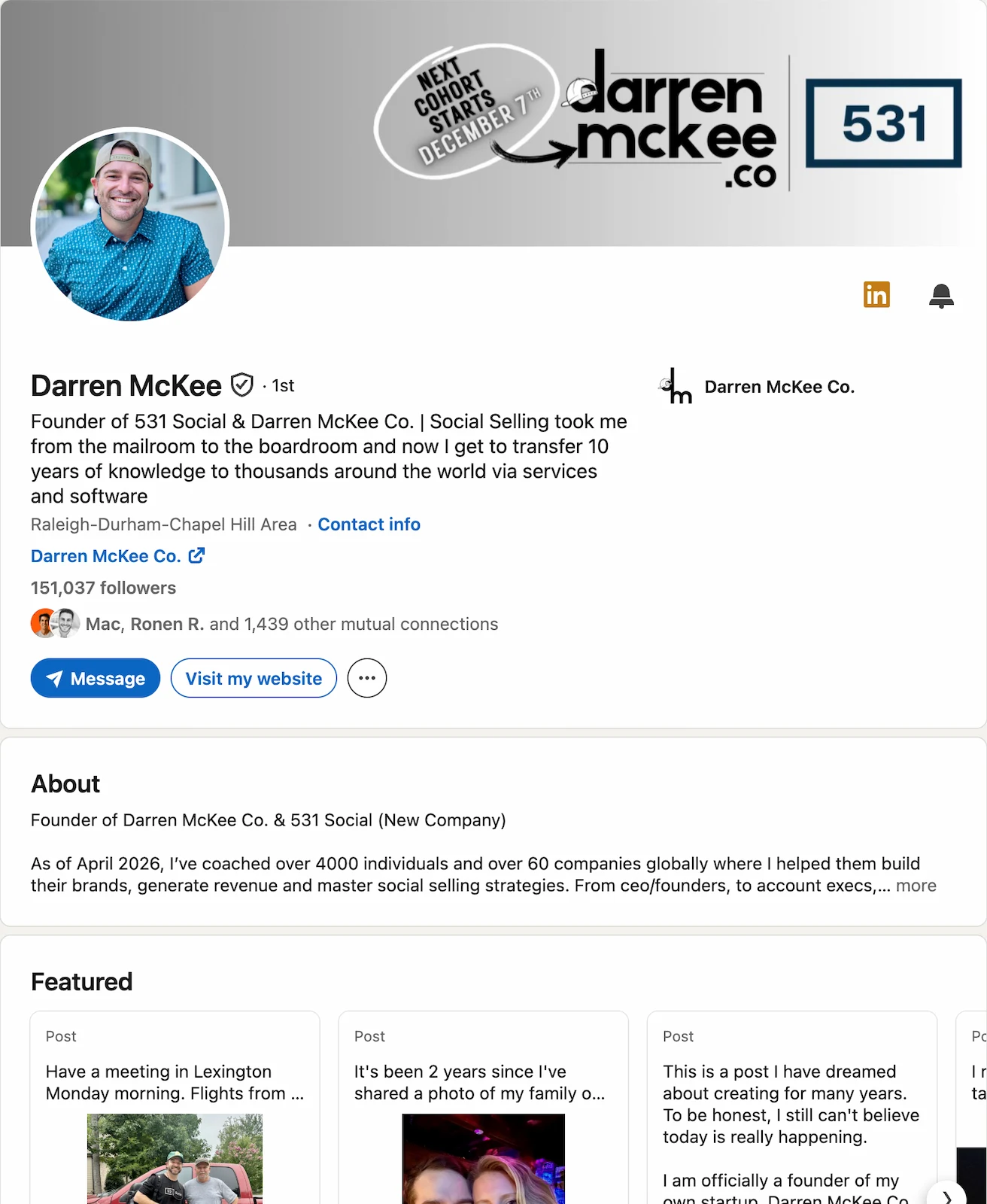
Darren McKee’s sales career went, in his words, from the mailroom to the boardroom, including enterprise AE at BetterUp, Director of Growth at Wellthy, and VP of Sales and Strategic Partnerships at Skye, before he went full-time on training. Along the way he posted on LinkedIn every day for over 1,000 days straight and grew from 3,000 to 150,000 followers with no paid ads and no automation. That track record is the product. He teaches the same playbook he used, and you can check the receipts on his own profile.
The offer is built around live teaching. There is a monthly LinkedIn and Social Selling Cohort (three live online sessions, running since late 2023), team training for companies and sales teams, conference keynotes, and one-to-one coaching for leaders who want a profile and content audit with follow-up check-ins. For self-paced learners there is a four-module on-demand course, Zero to 140,000: The Art of LinkedIn and Social Selling. In 2025 he added 531 Social, an AI coaching product for sales teams that pairs software with his method. By his count, as of April 2026, he has coached more than 4,000 individuals and over 60 companies worldwide.
The style is human-first: real relationships, stories from actual deals, and content that ignores most “LinkedIn best practices.” He has been named to Lead411’s top 20 sales influencers on LinkedIn, Built In’s sales reps to follow, and LinkedIn’s own sales blog cites him as a Sales [In]sider. He is based in the Raleigh-Durham area of North Carolina. This entry is based on public evidence rather than direct client feedback.
Site: darrenmckee.co · 531social.com · Profile: linkedin.com/in/darrenmckeesales
Not the right fit if: you need a big multi-country enterprise rollout, or your team wants a formal Sales Navigator curriculum more than a posting and outreach habit. This is one practitioner teaching his own method, and the one-to-one coaching is priced at a premium.
Why he stands out
- Grew his own audience from 3,000 to 150,000 followers with no ads or automation, then turned that into the curriculum
- A decade of social selling on top of a sales career that included VP Sales at Skye and enterprise AE at BetterUp
- Monthly live cohorts, team training, keynotes, 1:1 coaching, and an on-demand course
- 4,000+ individuals and 60+ companies coached by his count, as of April 2026
- Recognized by Lead411, Built In, and LinkedIn’s sales blog as a Sales [In]sider
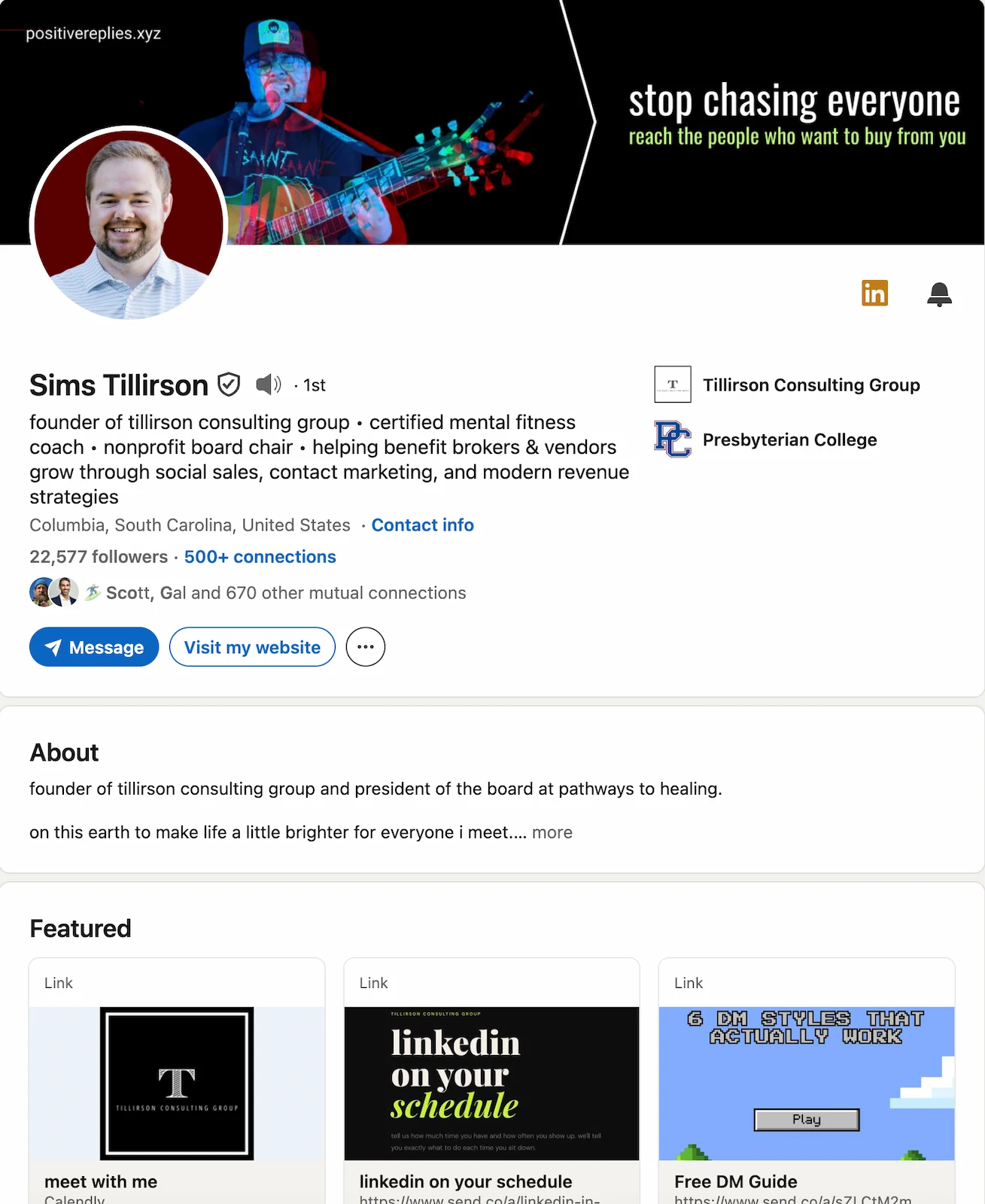
5) Sims Tillirson (Tillirson Consulting Group)
Best for: Employee benefits brokers, HR-tech and benefits-tech sales teams, and insurance producers who want social selling coaching from someone who has sold inside their industry.
Most LinkedIn trainers teach a general playbook and leave you to translate it to your market. Sims Tillirson is the opposite kind of pick: a specialist for one industry. He spent more than ten years in employee benefits sales and go-to-market roles, including Regional Director of Consultant Relations at Alight Solutions and SVP of Sales and Broker Partnerships at Blue Raven Actuarial, and has been social selling in that world for about six years. In 2024 he founded Tillirson Consulting Group in Columbia, South Carolina, to coach the people he used to sell alongside.
The offer is training and coaching for groups that want to get better at prospecting, social selling, and what he calls pattern disruption, plus keynotes (“Impossible to Ignore” is the LinkedIn one). He has co-led group coaching cohorts with weekly sessions, and his method is a simple daily system: expand your network with 10 to 20 connection requests, engage with 10 comments, publish content that teaches or entertains, and send five video or audio DMs. His line that “posting on LinkedIn is not social selling” sums up the approach. Content earns attention, and the outreach turns it into revenue.
He also contributes to Revenue Magazine and shows up regularly on benefits and HR-tech podcasts, which is where his audience lives. This entry is based on public evidence rather than direct client feedback.
Site: tillirsonconsulting.com · Profile: linkedin.com/in/simstillirson
Not the right fit if: you are outside employee benefits, insurance, or HR tech, or you need a large, productized program with published pricing. This is a boutique practice with a deliberately narrow lane, and that narrowness is the reason to hire him.
Why he stands out
- Industry specialist: 10+ years selling employee benefits before coaching in it
- A concrete daily system for connecting, commenting, posting, and video DMs
- Measures social selling by revenue, and says so bluntly
- Group cohorts, team training, and keynotes rather than done-for-you content
- Active in the benefits and HR-tech community through Revenue Magazine and industry podcasts
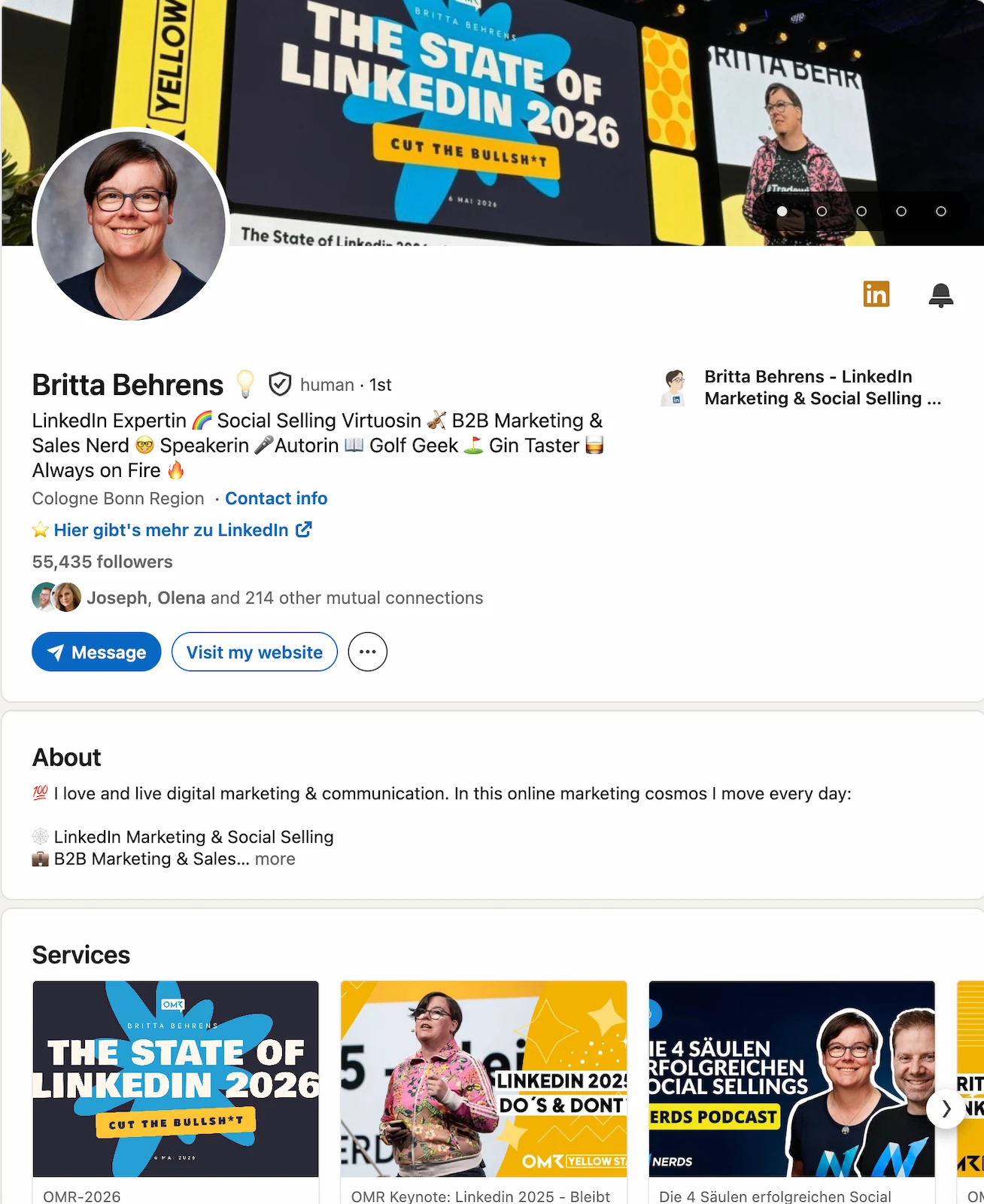
6) Britta Behrens
Best for: DACH companies that want social selling and corporate influencer programs rolled out to marketing and sales teams, delivered in German or English.
Britta Behrens is a Cologne-based LinkedIn marketing and social selling trainer, author, and speaker, and one of the first 36 people worldwide to earn the LinkedIn Certified Marketing Expert credential. Her work is advising companies on how to set up social selling and corporate influencer programs (the German-market term for employee advocacy), then training the marketing and sales teams who run them. She also does CxO personal branding for executives who need to lead by example.
Her public formats are “LinkedIn like a Boss” masterclasses, LinkedIn marketing bootcamps, and keynotes. She gave the “State of LinkedIn 2026” keynote at OMR in May 2026, is an OMR Education expert and a regular on their podcast, and speaks at OMT and OMKMS. She co-hosts LinkedIn Local Cologne. Public masterclass and bootcamp dates run through August and September 2026, so the practice is clearly active. This entry is based on public evidence rather than direct client feedback.
The reason she makes the list over other German-speaking trainers is fit: her offer is explicitly team training and program rollout, not ghostwriting, and it comes with the LinkedIn certification and a long conference track record behind it.
Links: linktr.ee/brittabehrens · Profile: linkedin.com/in/britta-behrens
Not the right fit if: you need a large multi-country rollout with a big bench of trainers. This is a boutique practice. For that scale in Europe, look at Just Connecting.
Why she stands out
- One of the first 36 LinkedIn Certified Marketing Experts worldwide
- Focus on corporate influencer programs, the DACH version of employee advocacy
- Trains marketing and sales teams in German and English
- OMR keynote speaker (“State of LinkedIn 2026”) with a steady conference and podcast presence
- Public masterclasses and bootcamps on the calendar through late 2026
How to choose between them
Work through these in order and the shortlist usually narrows to one or two.
1. Decide if you actually need a trainer. One executive who needs content written wants a ghostwriter. A company page that needs running wants an agency. A group of people who need to get good at LinkedIn themselves wants a trainer. Mixing these up is the most common mistake in this category.
2. Match the language and the market. Selling into Italy? Bellini. Germany, Austria, or Switzerland? Behrens. Several European countries at once? Just Connecting. US sales team? McEwen or McKee. Selling employee benefits or HR tech? Tillirson. This one decision does most of the work.
3. Match the audience. Sales teams need Sales Navigator, messaging, and prospecting. Executives need profile and content strategy. Employee advocates need permission, a simple posting habit, and a reason to keep going. The trainers above split roughly along those lines, and the good ones will tell you which of their programs fits.
4. Pick a format you will actually finish. A one-day workshop is cheap and forgettable. A 12-week program with coaching costs more and sticks. On-demand courses only work if a manager holds people to them. Be honest about your team.
5. Ask how they measure success. The right answer includes activity 90 days later, movement in Social Selling Index, and pipeline the sales team can point to. The wrong answer is workshop attendance and a satisfaction survey.
Red flags when hiring a LinkedIn trainer
- They sell followers, run engagement pods, or teach your team to game the algorithm instead of writing something worth reading.
- They hand out post templates and call it a content strategy. Templated posts from twenty salespeople look like spam because they are.
- They run the same workshop for sales, marketing, and HR. Those groups need different skills.
- They cannot name a client whose team was still posting six months after the training.
- They have no Sales Navigator depth but are pitching to a sales team.
- They promise leads from a single workshop. Training changes behavior; behavior produces leads over months, not days.
Trained the team? Give them one place to post
DemandBird keeps trained people posting after the trainer leaves: capture ideas, draft in each person's voice, run approvals, and schedule across LinkedIn and eight other networks from one workspace.
Frequently asked questions
How much does LinkedIn training cost?
Published prices are rare, so plan on getting a quote. A few reference points: on-demand team programs start around $1,000 per person (Luminetics’ Modern Social Seller), and individual memberships like Just Connecting’s TRIBE run about €1,000 a year. Live team workshops and multi-week corporate programs are priced per engagement, and multi-country enterprise rollouts cost far more. Ask every trainer for a per-person number so you can compare like with like.
What is the difference between a LinkedIn trainer, a ghostwriter, and an agency?
A trainer teaches your people to do the work themselves: profiles, posting, messaging, and Sales Navigator. A ghostwriter does the writing for one executive. An agency runs the channel for you, often including the company page and paid ads. Training is the right buy when you have a group of people (a sales team, a leadership team, or employee advocates) who need the skill to stay in the building after the engagement ends.
Should we train the whole company or just the sales team?
Start with the people who have the clearest reason to be on LinkedIn every week: sales, founders, and senior leaders. Once they are active and getting results, widen to an employee advocacy program built on volunteers. Company-wide mandatory training tends to produce a burst of activity that dies within a month, because most people were never going to post anyway.
How do we know if LinkedIn training worked?
Measure behavior first and pipeline second. Behavior means how many trained people are still posting, commenting, and sending messages 90 days later, plus movement in their Social Selling Index. Pipeline means replies to outreach, meetings booked, and deals where LinkedIn touched the buyer. If activity fades after a month, the training did not stick, no matter how good the workshop felt on the day.
Can AI replace a LinkedIn trainer?
AI can draft posts, rewrite profiles, and suggest replies, and most trainers on this list now teach with AI tools built in. What AI does not do is change habits, hold a sales team accountable, or tell a CEO that their content strategy is wrong for their market. That is the part you pay a trainer for.
Do we still need a scheduling tool after training?
Usually, yes. Training fixes the skill gap. It does not fix the workflow gap: where ideas get captured, who approves a post before it goes out, and how ten people publish consistently without a group chat. A team tool with drafting, approvals, and scheduling is what keeps trained people posting after the trainer leaves.
Final thought
The best LinkedIn training you can buy is the one your team is still using in six months. That depends far more on language, format, and follow-through than on how famous the trainer is.
So pick by market first, audience second, and format third. Then hold the trainer to a number: how many of your people are still active, and what came out of it. Any of the six above can pass that test with the right team in the room.