
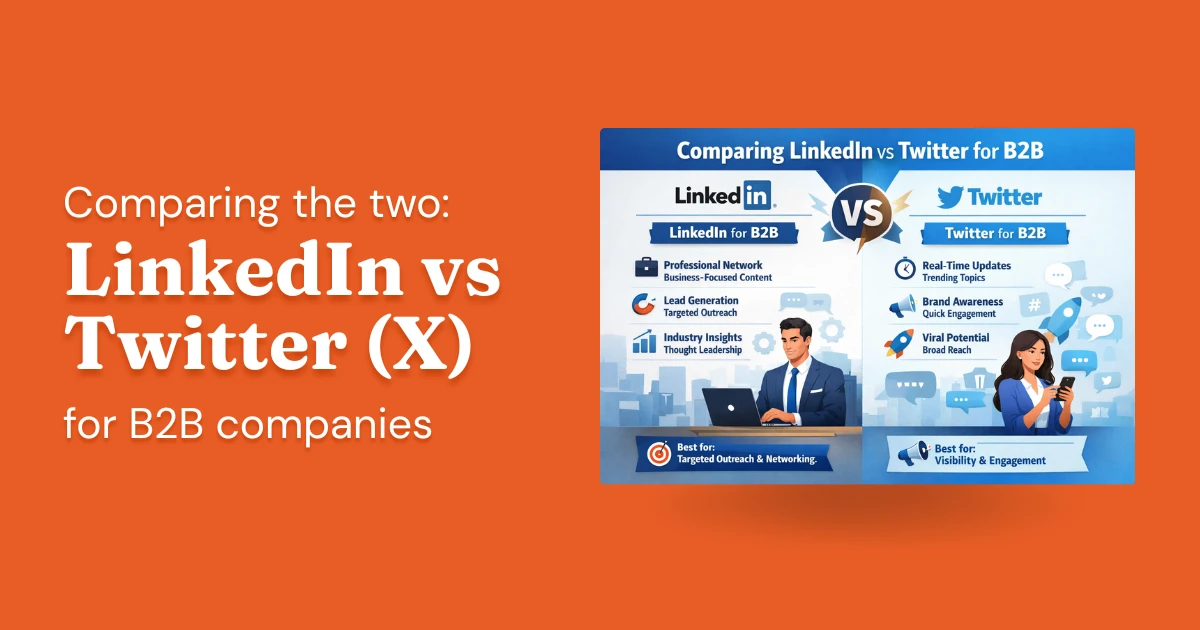
LinkedIn and Twitter (now X) both have real B2B use cases, but they're genuinely different platforms: different audiences, different intent, different modes of engagement. Figuring out which one to focus on, or how to use both without spreading yourself thin, is one of the more practical decisions in B2B social strategy.
This isn't one of those "it depends" articles. I'll give you a direct answer, explain the reasoning behind it, and leave you with a framework to make the call for your own situation.
- LinkedIn wins for most B2B use cases; it has the professional intent, the audience size, and the content formats that actually create pipeline.
- Twitter/X still works in specific B2B niches: SaaS, fintech, developer tools, policy, and founder-led brands with strong opinions.
- Personal profiles outperform company pages on both platforms. No exceptions worth worrying about.
- If you're time-constrained, pick one and go deep. A thin presence on two platforms produces weak results on both.
- Don't cross-post. Each platform needs content written natively for it.
The Short Answer
For most B2B businesses (companies selling to mid-market or enterprise buyers, professional services firms, anyone whose customers are decision-makers at other companies), LinkedIn is the better default choice. It has roughly one billion members, professional intent that no other platform comes close to, and a content environment where long-form storytelling and genuine thought leadership actually work.
Twitter/X is the better choice when your buyers are concentrated there: developer-focused products, crypto and fintech, policy and media, early-stage founder communities. It also works well as a secondary channel for founders who want a more casual, real-time voice alongside their LinkedIn presence.
The question isn't which platform is objectively better. It's which platform your specific buyers use, and which one you can sustain with quality content.
LinkedIn for B2B
LinkedIn was built for professional networking, and that intent shapes everything about how the platform works. People show up on LinkedIn in work mode, thinking about their careers, their businesses, their industries. That's a fundamentally different headspace from someone scrolling Twitter first thing in the morning to catch up on news and drama.
Why LinkedIn works for B2B
- Professional intent at scale. With roughly one billion members, LinkedIn puts your content in front of an audience that's already thinking about work. 79% of B2B marketers say it's their top source for leads; nothing on Twitter comes close to that number.
- Decision-maker density. No other social platform has as high a concentration of executives, directors, and VPs. If your product sells to people with actual buying authority, that's where they are.
- Content formats that support real ideas. LinkedIn handles long-form text posts, carousels, documents, video, and newsletters. You can make a complete argument, tell a full story, or walk someone through a framework in a single post. That kind of depth converts better in B2B than hot takes do.
- Profile as a landing page. Every piece of content you publish links back to your profile, which functions as a lightweight sales page. A well-optimized LinkedIn summary and Featured section can turn profile views into real conversations, with no paid spend required.
- Organic reach is still meaningful. LinkedIn's algorithm still gives organic posts real distribution, especially from personal profiles. That's increasingly hard to say about other mature social platforms.
LinkedIn's limitations
- The platform suppresses posts with external links in the body. You need to work around this: put links in the first comment, or use native formats like documents.
- Good LinkedIn content takes real effort. A strong post takes more thought and time than a tweet, so the production cycle is longer.
- Company pages consistently underperform personal profiles. If you can only manage one, a founder or team member's personal profile will always do more work than a brand account.
Twitter/X for B2B
Twitter (X) has roughly 600 million registered users globally, with an active daily user base around 250 million. The platform rewards brevity, real-time takes, and personality. It doesn't naturally suit the careful, considered content that tends to convert in B2B; but there are real exceptions.
When Twitter/X works for B2B
- Developer and technical audiences. If your product is a developer tool, API, or technical infrastructure play, Twitter is still where a meaningful chunk of that audience lives and talks publicly.
- Fintech and crypto. These communities are more concentrated on Twitter than almost anywhere else. Deal flow, hiring, product announcements, and the inevitable debates all happen there.
- Founder-led brands with strong opinions. Opinionated founders who enjoy real-time debate and back-and-forth can build genuine audiences on Twitter. If that's authentically how you think and communicate, it works. Most brand accounts, though, get nowhere.
- Policy, media, and journalism-adjacent B2B. If your buyers include journalists, analysts, or policy people, Twitter is still where those conversations start.
- Speed. When something is happening in your industry right now, Twitter is faster than LinkedIn for getting a take out quickly.
Twitter/X's limitations for B2B
- Organic reach has become unpredictable since 2022. Algorithm changes, verified account overhauls, and user departures have knocked down reach for a lot of creators.
- Brand profiles almost never work. The Twitter B2B success stories you hear about are personal account stories, essentially without exception.
- The character limit makes nuanced B2B arguments genuinely hard. Threads help, but most people don't read them all the way through.
- Attribution is messier. Twitter traffic tends to convert at lower rates than LinkedIn traffic across most B2B categories.
The platform risk factor under Elon Musk
This deserves its own section. It's a real business consideration, not just a personal opinion about the platform.
Since Elon Musk's acquisition in 2022, Twitter has overhauled its content moderation policies, reinstated previously banned accounts, and taken on a noticeably different political and cultural character. For a lot of B2B companies, that creates a category of risk that simply didn't exist before:
- Brand safety. With reduced moderation, the content appearing next to your posts is harder to predict. Your company's name can sit adjacent to things your customers or employees find objectionable; on Twitter that adjacency is visible in ways it isn't on LinkedIn.
- Platform association. Some B2B buyers, particularly at enterprise companies with explicit social media policies, now have internal guidance that accounts for the platform's ownership and culture. Being active on X carries implicit associations that weren't part of the calculation before 2022.
- Employee and stakeholder concerns. If your team has members who object to the platform on political or ethical grounds, asking them to build a presence on X can create friction that LinkedIn simply doesn't.
- Advertiser unpredictability. Major advertisers have repeatedly paused spending on X over brand safety concerns. That tells you something about the platform's risk profile even if you're only doing organic content.
None of this means Twitter/X is off-limits for B2B. Plenty of companies operate there effectively. But it does mean the platform carries a reputational variable that LinkedIn doesn't; in conservative industries like financial services, healthcare, legal, or enterprise software, that's worth factoring into your decision rather than brushing past it.
Head-to-Head Comparison
| Twitter/X | ||
|---|---|---|
| Active users | ~1 billion members | ~250M daily actives |
| Audience intent | Professional, career, business | News, debate, community |
| B2B lead gen | 79% of B2B marketers rate it #1 | Works for specific niches |
| Best content type | Long text, carousels, documents | Short takes, threads, real-time |
| Personal vs brand | Personal profiles win | Personal profiles only |
| Organic reach | Meaningful, algorithm-supported | Declining and unpredictable |
| Best B2B niches | Most professional B2B categories | Dev tools, fintech, founders |
| Profile as sales tool | Strong (summary, Featured, headline) | Weak (bio only) |
| Content production | Higher effort per post | Lower effort, higher frequency |
How to Decide
Work through these four questions in order. By the end, the answer should be pretty clear.
1. Where are your buyers?
This is the only question that really matters. All the platform statistics in the world mean nothing if your specific buyers are concentrated somewhere different. Talk to your customers. Look at where they post, comment, and engage publicly. If they're mostly on LinkedIn, that's your answer. If they're mostly on Twitter, that's your answer. If they're on both, you've got more flexibility.
2. What kind of content suits your voice?
LinkedIn rewards considered, longer-form thinking. If you naturally gravitate toward carefully argued posts, teaching frameworks, or stories from your work, LinkedIn will suit you well. Twitter rewards brevity and confidence: hot takes, strong opinions in one sentence, real-time reactions. If that's more natural to you, Twitter might produce better results even if LinkedIn is technically the higher-leverage platform for your category.
3. How much time do you actually have?
Managing two platforms well takes more than twice the effort of managing one. Don't spread yourself thin. A mediocre presence on two platforms produces worse results than a strong one on either. If you're a solo founder or working with limited social media bandwidth, pick the platform where your buyers are and go deep there first. You can always add a second platform once the first is running well.
4. What are your competitors doing?
Look at how competitors are using each platform, not to copy them, but to find the gap. If your category is full of mediocre LinkedIn company page posts and nobody's doing good personal content, that's an opening. If everyone in your space is already strong on LinkedIn but ignoring Twitter, that might be worth exploring. The goal is to find where you can stand out, not just where the crowd already is.
Using Both Together
If your audience uses both platforms and you have the bandwidth, there's a real case for doing both; but only if you're creating natively for each. Cross-posting the same content from one platform to the other almost always falls flat on the receiving end.
LinkedIn content
- Long-form text posts with a clear point of view
- Carousels that teach something step-by-step
- Documents with data or frameworks
- Stories from real client work or company building
- Newsletter posts if you have a following
Twitter/X content
- Shorter hot takes on industry news
- Threads that expand a LinkedIn idea briefly
- Real-time reactions during events or product launches
- Direct engagement in ongoing community debates
- Behind-the-scenes founder content
A pattern that works well in practice: use Twitter for shorter, more frequent, more casual content that builds personality and real-time relevance. Use LinkedIn for deeper, more polished posts that build credibility and drive direct commercial conversations. The two reinforce each other rather than competing for the same energy.
You can also let one platform inform the other. A concept you tested briefly on Twitter might be worth developing into a full LinkedIn post with data and context. A reaction you had during a live event on Twitter can become a considered take on LinkedIn once you have had time to think it through properly.
What to Measure
One of the most common B2B social mistakes is optimizing for numbers that feel good but have no bearing on revenue: follower counts, likes, raw impressions. Both LinkedIn and Twitter surface these numbers prominently, which makes it easy to confuse activity with results.
Here's what actually matters:
- Profile views from content. On LinkedIn especially, this is a leading indicator of inbound interest. If your posts are driving people to your profile, some of those people are sizing you up as a potential partner or vendor.
- Inbound conversations started. Track how many DMs, connection requests with a note, or direct email inquiries mention something you posted. That's the clearest signal that your content is creating real pipeline.
- Search appearances. LinkedIn tells you how many times your profile showed up in search results and for which keywords. It's a useful proxy for how well your profile is optimized and whether your keyword positioning is working.
- Engagement quality over quantity. A post with 12 comments from the right people in your ICP is worth more than 200 likes from random connections. Look at who's engaging, not just how many.
- Content performance over time. Track which post types, topics, and formats generate the most meaningful engagement and profile views. Double down on what's working instead of endlessly testing new formats.
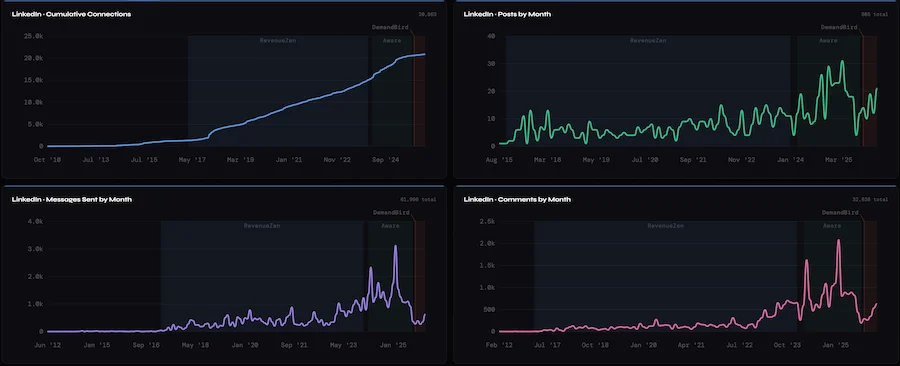
If LinkedIn is your primary channel, DemandBird gives you strategic analytics on your personal profile: post performance history, audience engagement trends, and content insights that show you what's actually driving commercial outcomes, not just impressions. You can read more about what LinkedIn analytics actually shows you and where the gaps are.
For a broader look at optimizing your LinkedIn presence beyond content alone, see our guide to LinkedIn profile optimization.
Frequently Asked Questions
Is LinkedIn or Twitter better for B2B marketing?
LinkedIn is better for most B2B use cases. It has a larger professional user base, more formats for long-form and visual content, and generates roughly 80% of B2B social media leads. Twitter/X works well for specific audiences, particularly in tech, finance, and policy, but as a primary channel it's a much harder bet for most businesses.
Should a B2B team maintain a presence on both LinkedIn and Twitter?
Yes, and for some audiences it makes a lot of sense. The key is not cross-posting the same content. LinkedIn favors longer, more considered posts; Twitter rewards brevity and hot takes. If you have the time to create natively for each platform, doing both can meaningfully extend your reach. But if you're time-constrained, pick one and go deep rather than spreading thin across both.
What type of content works best on LinkedIn for B2B?
Long-form text posts that teach something, share a contrarian take, or tell a real story from your business tend to do well. Carousels and documents also get strong dwell time. Video works, but it requires more production effort. The biggest differentiator on LinkedIn is personal voice; posts from individual profiles almost always outperform company page posts.
Is Twitter still useful for B2B in 2026?
Twitter/X still has concentrated pockets of B2B value, particularly in SaaS, fintech, policy, and developer communities. If your buyers actively spend time there, it's worth having a presence. But the platform has become less reliable as an organic reach channel since 2022, and most B2B companies will get more pipeline per hour invested on LinkedIn.
Should I use a company page or personal profile for B2B social media?
Personal profiles, on both platforms. Company pages on LinkedIn and brand accounts on Twitter almost universally underperform personal profiles in reach, engagement, and inbound lead generation. Build your personal presence first. A company page can act as a supporting directory, but it shouldn't be where you're putting your time and content.
Manage LinkedIn and Twitter from one place
DemandBird helps founders, consultants, and agencies schedule, repurpose, and analyze content across LinkedIn and Twitter — so you spend less time on logistics and more time on what actually converts.
Start Free Trial