
Hi, I'm Alex. I have over 20,000 LinkedIn connections and over 30,000 followers, and have sourced well over $8M in revenue from my LinkedIn presence over the last decade or so:
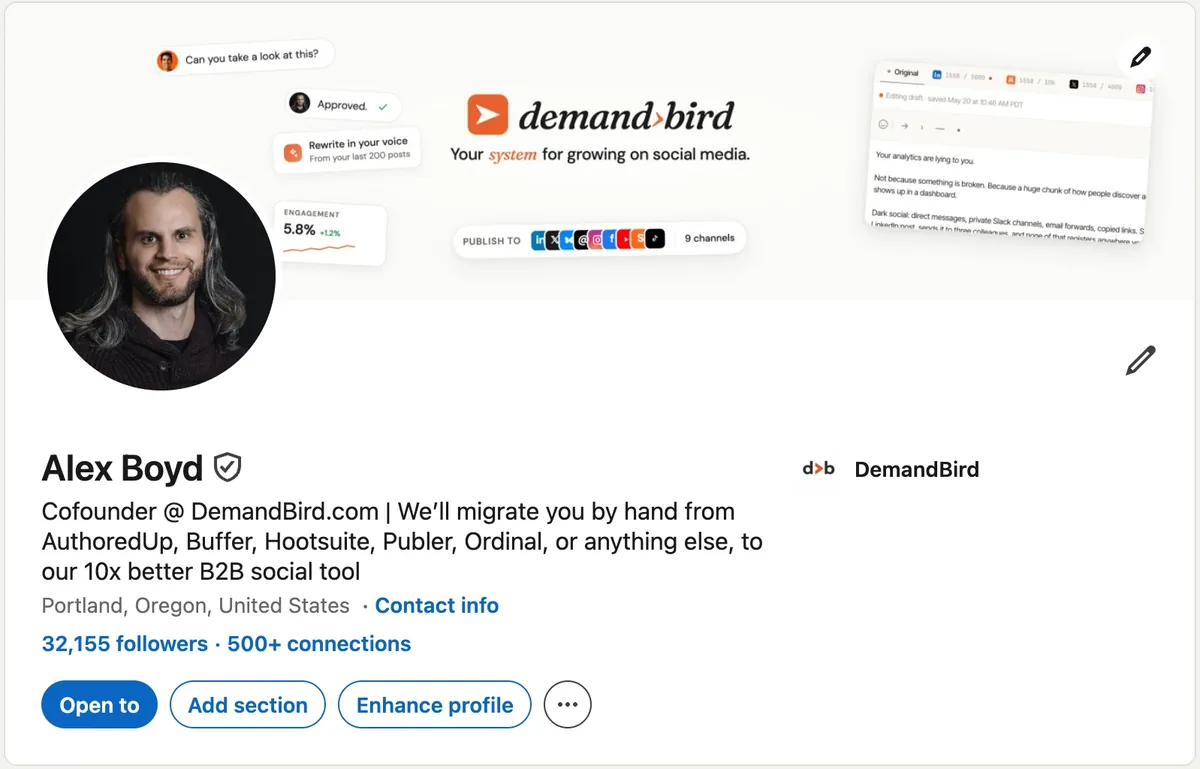
That said, I was doing well on LinkedIn when I had only 2,000 connections and roughly the same in followers. Don't stress over the number. It isn't what's blocking your pipeline growth.
Most likely, you're not really here because you want more LinkedIn connections. You're here because you want two different things:
- more high-quality professional relationships, and
- a larger audience of people who you want to see your content.
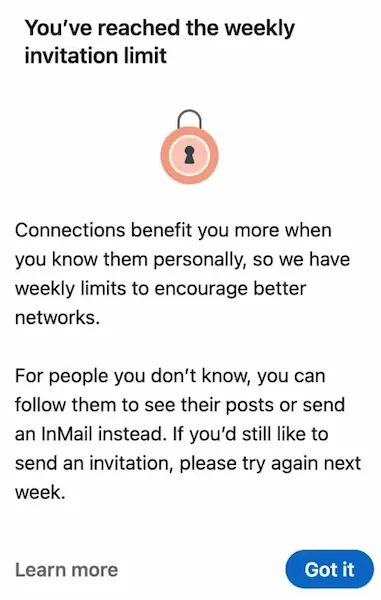
Both are good things to want. But they're different. If you "just connect with more people" but they aren't the right people, that'll get you ignored or your account flagged:
Or, say you succeed and fill your network with LIONs (LinkedIn Open Networkers). Now you have a list of people who joined in the mid-2000s and have been collecting connections ever since. That's probably not your buyer.
In any case, you can send 100–250 connection requests per week via desktop, with the higher end available if you have Premium and a good Social Selling Index (SSI) score. And honestly? This is more than enough if you're building your network in a high-quality way.
And yes, there is such a thing as too many connections. If too many of yours are inactive or off-topic, they quietly drag down your reach. I'll show you how to spot that and prune them further down.
Why your connection count actually matters (and where people go wrong)
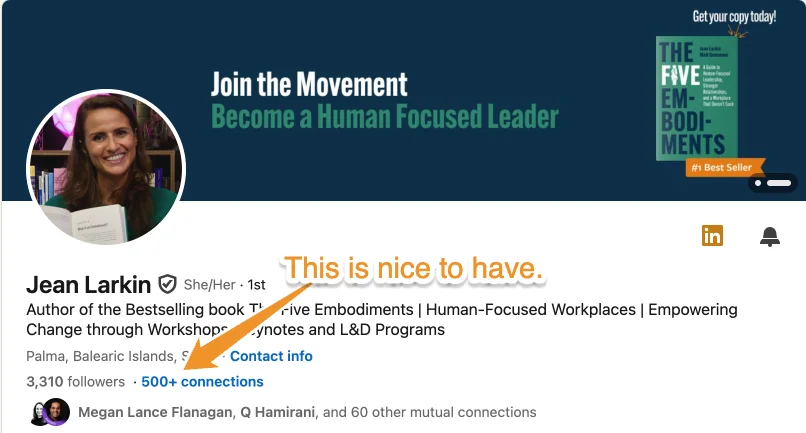
The 500+ connection threshold is real, in a psychological sense: you sort of "look like someone who's at least somewhat networked" to those who don't know you at all:
But don't confuse "having lots of connections" with having a good LinkedIn strategy. If you have irrelevant connections in your network, your post engagement rate will be low. LinkedIn will see this and conclude, "This person's content is not very valuable to their connections. Let's show it less often and to fewer people."
Boom: now you're in low-reach jail. Good luck trying to break out; it's not easy, and involves manually removing a ton of connections, one by one, and then letting time do its thing. Ouch. Even with a connection removal tool, it's painstaking.
So before you go out and get connections on LinkedIn by the hundreds, let's dial in the basics.
Before you send a single request: get your profile right
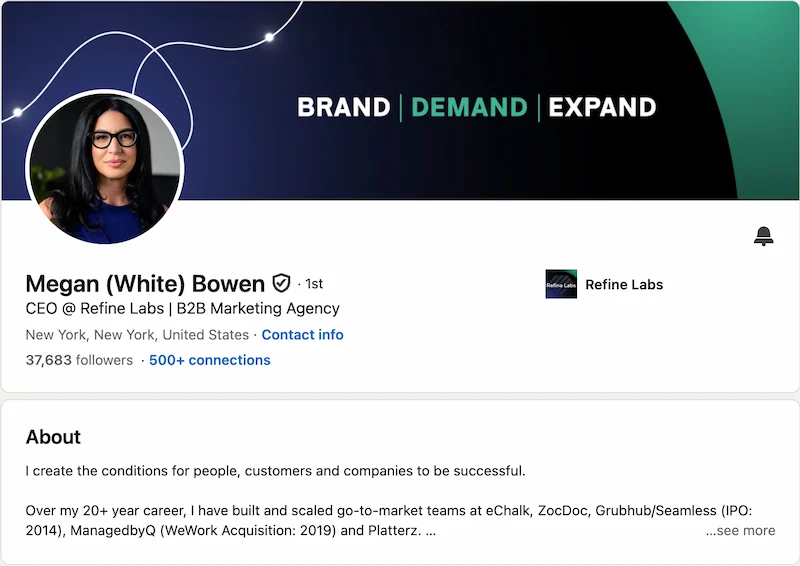
Pull up your profile and look at it with the critical eye of someone who just got a notification saying you'd like to connect. They don't know you. They're going to spend about three seconds deciding whether you're worth knowing before they hit accept or ignore.
(What you really want to avoid is them clicking "Ignore" followed by "I don't know this person"!)
Fix your photo. It doesn't need to be a professional headshot, but it needs to look like a real person who shows up to work. If it's blurry, cropped from a group photo, or makes you look 17, you're setting yourself back for no reason. ChatGPT can turn an Instagram photo into a passable headshot in under a minute; there's no excuse.
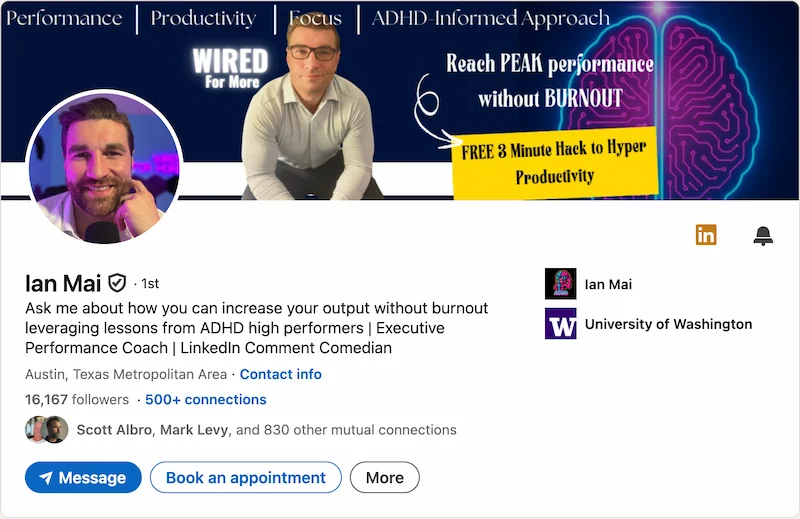
Write a decent headline. This is the single biggest lever alongside your photo. Your headline appears directly under your name in every connection request notification. Ask yourself: does this headline make me look like someone worth knowing in my industry?
For a deeper dive on how to write a great headline (including the 66-character truncation problem and how to signal credibility by role), read my LinkedIn headline examples guide. It has formulas and examples you can steal.
The first few lines of your About section are the tiebreaker. If someone isn't quite sure about you from your headline and photo, they might glance at your About section. Write it in first person, be specific about what you do and who you do it for, and don't bury the good stuff below a "see more" click.
If you want the full framework I use here, including how to structure the first lines and when to put your website near the top, read my guide to LinkedIn summary examples.
Cover these bases and you'll convert a much higher share of requests from people worth knowing.
How to get connections on LinkedIn that actually matter
Most people jump straight to cold outreach and are baffled when nobody accepts. Don't start there. Work in priority order, and hold off on cold prospecting until your network has real density and people in it who can vouch for you through familiarity.
Start with warm contacts
Former colleagues, classmates, conference contacts, people you've emailed: start with anyone who would recognize your name. Acceptance rates are high, and the compound effect matters. One good warm connection puts you a single degree away from dozens of people you'd genuinely want to know.
LinkedIn lets you import your email contacts directly and find matches; it's underused and worth doing once.
Second-degree connections of people you respect
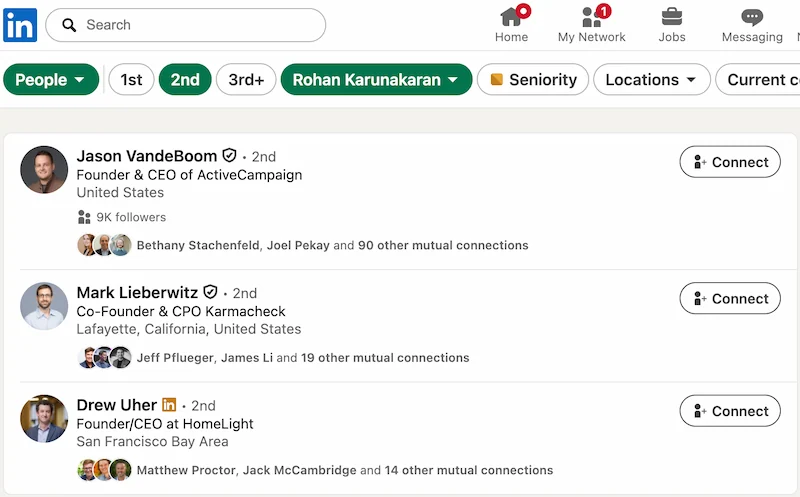
Once you've worked through warm contacts, go peer-browsing. Find someone you know well who's a 1st connection, and browse their connections list. These people are already pre-filtered by someone with similar professional sensibilities. You'll find better signal here than you ever will from an advanced search full of strangers.
Don't worry about the etiquette: merely connecting with someone on LinkedIn is pretty low in terms of signal strength. You're not offending anyone's privacy just because you sent a connection request.
People who engaged with relevant content
Regular commenters on content in your space have already demonstrated that they're active participants, not just passive profile-holders. They're paying attention to the same conversations you are. That shared context makes them more relevant connections and better bets for an acceptance.
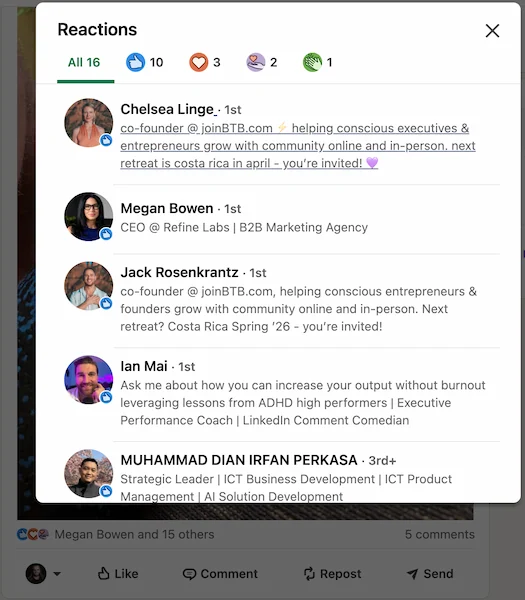
Do try to engage on their content first (a genuine comment, not a "great post!") then send the connection request. But do not, dear holy God in heaven, use this as an opportunity to pitch them something irrelevant without having paid any attention to what this person is working on. That's a quick way to rush familiarity and get blocked. Engage and connect because you, too, are genuinely interested in whatever they're talking about.
Who to skip (for now)
Skip cold 3rd-degree outreach until you've exhausted warmer targets. I almost never send a cold 3rd-degree request; building shared context first (through content, comments, or events) is almost always more efficient. As a rough threshold: 500+ quality connections and 10+ average post engagements before you go fishing in cold water.
How to write a connection request that actually gets accepted
First: you don't have to include a note. Most of my requests go out blank, particularly to warm contacts, second-degree connections, or people who've seen me commenting in their feeds. A note on every request doesn't lift your acceptance rate; if anything it can lower it, because unless it's immediately obvious you're not pitching anything, you'll pattern-match with every sales message in their inbox.
Write a note when you have something genuinely specific to say. That's it.
When you do write one, you have 300 characters. This is a forcing function, not a limitation. It's enough room to say one real thing. The goal is simple: show the person you actually know who they are. Sam McKenna calls this "Show Me You Know Me," the idea that the fastest way to earn someone's attention is to demonstrate, specifically, that you've paid attention to theirs.
Things that work well
- A shared context: "We were both at MicroConf last month; great talk you gave on pricing. Made me think through how we're doing packaging & plans :)"
- A specific genuine reason: "Looking forward to connecting; [colleague] mentioned putting us in touch soon as part of the XYZ engagement."
Just take your sales hat off and use your normal social skills. What would you send in a text message to someone you were hoping to meet?
Dumb stuff that gets you ignored and blocked
- "I'd love to connect and explore synergies": no credibility, no helpfulness, screams incoming pitch
- "We offer XYZ services": you haven't earned that yet. We don't know each other.
- Following up immediately after they accept with an offer; this is why people don't accept notes in the first place (more on what to send instead below)
The goal is simple: your headline, photo, About section, and request note (or deliberate absence of one) should combine to tell someone in under three seconds that you're worth connecting with. That's the whole job.
How to really connect with people on LinkedIn: DMs that work
Getting someone to accept your request is step one. If you want the connection to turn into a relationship (or a customer), at some point you'll send a DM.
Most DMs fail for the same reason: they back the reader into a corner. There's one question, and only one answer the sender wants to hear. The reader can feel it, so they ignore the message.
A good DM does the opposite. Here's what I aim for:
- Notice something relevant and connect it to you. Something they posted, built, or said. Make it specific enough that it couldn't be pasted into anyone else's inbox.
- Say why you're asking. If you're going to pitch, say so. People can smell a pitch hiding behind a "quick question."
- Give them lots of outs. Leave room to say no to several different things, so they never feel cornered.
- Be funny, if it fits. A little humor tells them a real person wrote this.
- Mention a mutual connection, in a normal way. One light line is plenty. Don't lean on someone's name to borrow credibility.
Of those, two matter most: the relevant tie-in, and giving the reader many ways to say no without feeling bad.
Two ideas from Chris Voss's Never Split the Difference help here. A calibrated question is an open "how" or "what" question that lets the other person answer in their own words. An accusation audit means saying the negative thing they might be thinking about you before they get the chance ("Forgive the assumption," or "I know this is a pitch"). Both lower the reader's guard.
Example 1: pitching a friend
My friend Hunter is a fractional AI CTO. To show a group of founders what I mean, I wrote the DM I'd send him if I were trying to sell him on DemandBird:
Hey Hunter, digging your development automation content, not enough of that is being posted here on LI vs on X.
Forgive the assumption, but - are you also using MCP/API for your social content? If so, is whatever you're using (Buffer, Hootsuite, etc) working for you? Asking because our MCP is badass, if you haven't tried it. I'm one of the cofounders of DemandBird.
Regardless, seems like you're pals with Monica Stewart too? That's cool if so. She's a badass.
Have a great rest of your eve in Atlantis
Here's what each part is doing:
- "Digging your development automation content...": a real thing I noticed, plus a small opinion about it (there isn't enough of it on LinkedIn). That shows I actually read his posts.
- "Forgive the assumption, but...": the accusation audit. I'm guessing about his setup, and I say so up front.
- "Is whatever you're using working for you?": an open question with an easy out. If he's happy with his tools, he can just say so.
- "Asking because our MCP is badass... I'm one of the cofounders": the reason I'm asking, out in the open.
- "Regardless, seems like you're pals with Monica Stewart too?": "Regardless" tells him the conversation doesn't hinge on the pitch. The mutual connection gives him a second, easier thing to reply to.
- "Have a great rest of your eve in Atlantis": a joke to close, since he lives in Atlanta. No call to action, no "let me know!"
Example 2: rewriting a pitch someone sent me
Then Hunter flipped it around and wrote a sample DM pitching me on his services (he helps teams ship product when their main developers are stretched thin). Here's how I'd write that message, to me, if I were him:
Hey Alex, DB's analytics feature looks killer. I use agents heavily, looks like a cool instance of not just reporting but letting AI do some of the interpretation too.
Out of curiosity, how's the design/dev process been? I see you're the non-technical one (Mac has your back as CTO, yeah?), but curious if the product dev velocity is where you want it? Asking since that's basically what I do... sit alongside tech teams as a second set of eyes on feature reqs as well as physically shipping stuff for you, when your primary team is bogged down.
Or if you're 100% good to go there and Github is rip roaring with 20+ PRs every day, maybe it's a conversation for "as you scale, maybe this is a helpful idea".
BTW Seems like you're part of the anti LinkedIn club too? Love the unhingedness of those folks. Hope they don't kick me out for pitching you. Ha.
Anyway thanks for reading, hope to connect in the coming months or quarters, keep crushing bootstrapper life 💪
Look at how many outs that gives me:
- "Our dev process is great and we're crushing it." The third paragraph hands me that answer. I can say it and end the conversation politely.
- "Yep, Mac's doing great." The question about our CTO lets me confirm and move on. Or, if something real were going on (say he was about to go on leave for six months), the message builds enough trust that I might actually tell him.
- "Ha, that group is great." I can reply to just the bootstrapper comment or the group joke. That part also tells me he isn't only after my contract developer budget.
"Hope they don't kick me out for pitching you" is another accusation audit. He names the awkward part (this is a pitch) and laughs about it, which takes the pressure off. And "as you scale, maybe this is a helpful idea" gives me a "not right now" option, which keeps the door open for later.
Yes, these are both pitches
Earlier I said not to pitch right after someone accepts. Both of these examples are sales messages, and that's fine. They work because each one is built on something real the sender noticed, says plainly what it's about, and makes saying no easy.
If you can't find something specific to say about the person, you're not ready to send the DM yet. Go engage with their content for a while first.
How often to add connections
Ignore any advice that prescribes a daily quota. You don't need a spreadsheet or a calendar reminder for this.
Do this consistently and your network grows at the right pace, full of people who have actual context for who you are. That's categorically different from a network assembled by blasting 100 cold requests a week.
Connection quality shapes content reach. A tighter, more relevant network beats a sprawling list of strangers on reach and engagement, almost every time.
Yes, you can have too many connections: when and how to prune
More connections isn't always better. If a big chunk of your network never engages with what you post, LinkedIn notices. Your engagement rate drops, your posts reach fewer people, and you slide toward the low-reach jail I mentioned earlier.
There's no magic number for how many LinkedIn connections you should have. Get past 500 for the credibility signal. After that, what counts is how many of your connections are active and care about what you do.
Signs you need to prune
- You changed industries. If you spent years in a field you've left for good, a lot of those connections won't care about your new work, and they never will.
- You were too loose with requests. You accepted everyone who asked, or sent requests to anyone with a pulse (maybe while chasing 500+). This is usually where the LIONs come from.
- Lots of your connections look inactive. No posts, no comments, no profile updates in years. They add to your count and nothing else.
- Your reach dropped and stayed down. Your impressions have been sliding for months, even though your posts are as good as ever.
Who to remove
Start with people who spam you, people from an old industry who never engage, and people whose posts clutter your feed. You don't have to remove anyone you actually know and like. When in doubt, ask yourself: would I want this person to see my next post?
How to remove connections on LinkedIn
- Click My Network, then Connections (under "Manage my network").
- Find the person, then click the three-dot menu next to their name.
- Click Remove connection, then confirm.
You can also open someone's profile, click More, and choose Remove connection. LinkedIn doesn't notify the person.
Doing this one person at a time is slow. If you have thousands to clear out, a connection removal tool makes it faster, though it's still work. Once you're done, give it time. Your reach should recover gradually as your posts start landing with people who care about them.
What about automation tools?
I have to talk about this because even though I don't personally use automation tools, many people do. If you've built a solid manual process and you insist on increasing volume, tools exist for that. Expandi and Dripify are more campaign-style tools; Phantom Buster is a solid all-around LinkedIn data tool; and Breakcold is honestly more in the realm of what we're talking about here: a way to build an outbound/CRM approach around LinkedIn, with both engagement and connection in one place.
Don't start here. Automation amplifies whatever you feed into it. A weak profile, fuzzy targeting, and clunky outreach messages will just produce those same results faster and at greater scale. Get the manual version working first.
And for what it's worth: I've generated millions in LinkedIn-sourced revenue without ever using connection automation tools.
Finally: revenue doesn't come from many connections, but from good ones
Keep adding the right people, keep pruning the ones who don't fit, and your network gets stronger every year.
The goal isn't the highest possible number; it's the highest possible signal. A high signal-strength network tells LinkedIn (and everyone who lands on your profile) that you're someone worth paying attention to.
Write once. Post everywhere.
DemandBird repurposes your best content for every platform and schedules it all automatically.